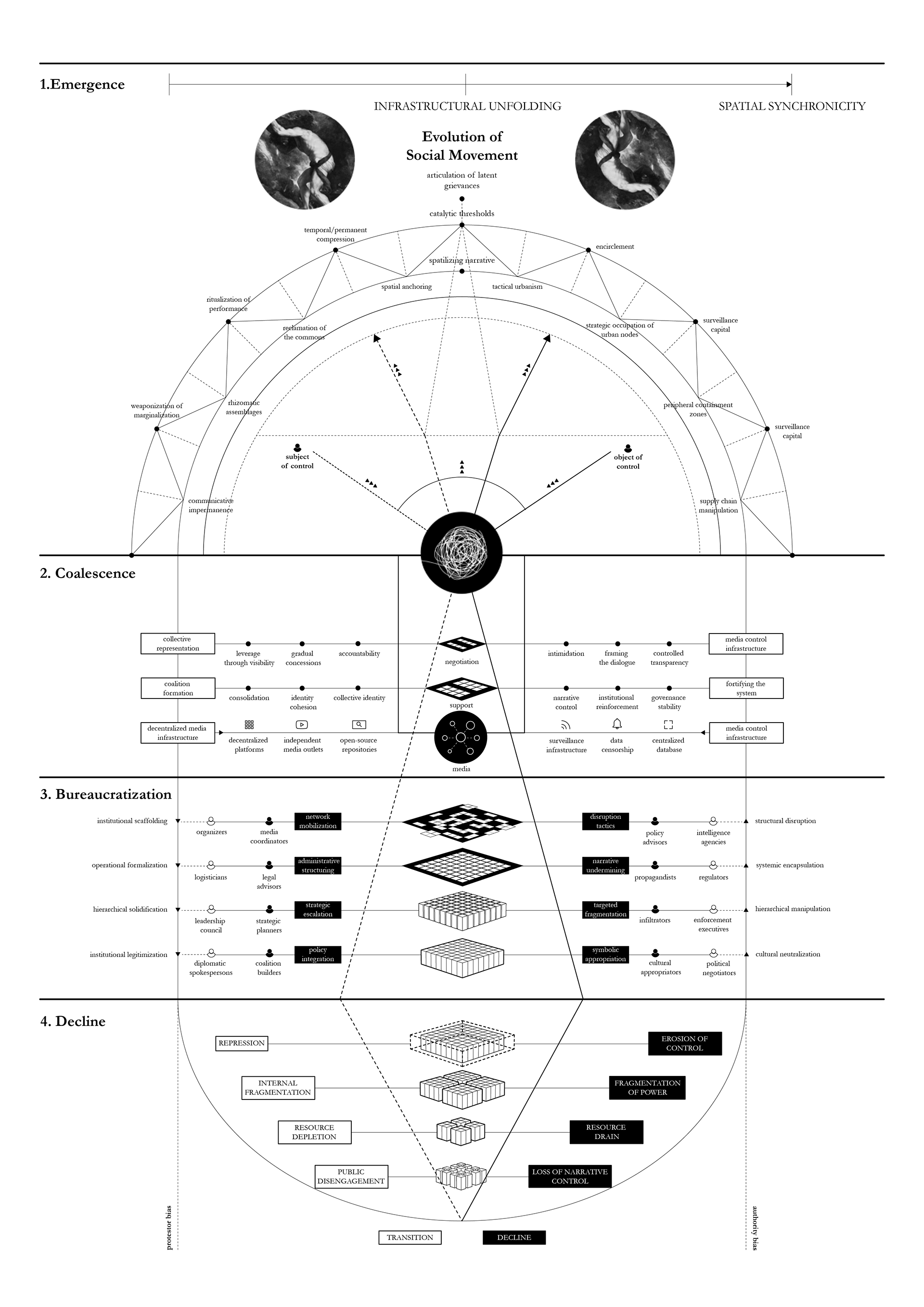
Image (Above): Evolution of a social movement diagram
Choreopolitics of Public Space
In the summer of 1518, the streets of Strasbourg were transformed by a bizarre and collective force: people danced uncontrollably for days in what became known as the “Dancing Plague.” Rather than simply a medical oddity, this episode blurred the boundaries between illness, ritual, and mass behavior. Public space itself was remade as a stage for involuntary choreography, exposing the potential of urban environments to host forms of movement that defy conventional order.
This project, Choreopolitics of Public Space, brings that same spirit to contemporary Tbilisi — a city whose public squares, avenues, and parks carry the weight of collective memory and civic unrest. By focusing on April 9 Park, a site deeply embedded in the trauma and resistance of Georgia’s political history, the design seeks to uncover how bodies in motion reclaim and re-script urban space. Protest here is not only political but spatial: people moving, gathering, dancing, dispersing.
Memory in this context is layered. Fleeting traces — banners, crowds, slogans — belong to the city’s short-term memory: vibrant, powerful, but inevitably fragile. At the same time, April 9 Park embodies long-term memory, rooted in the institutional and symbolic act of commemoration. These two temporalities coexist uneasily, raising important questions about which narratives we preserve, which we erase, and who gets to decide.
Architecture becomes a tool of intervention in this negotiation. By placing much of the program underground — a library, a club, an exhibition hall — the design preserves the surface park as a public symbol while creating hidden spaces for reflection, anonymity, and tactical retreat. Descending into the subterranean folds is more than a physical act: it is a ritual of memory, resistance, and re-emergence. In this way, architecture not only commemorates, but choreographs, contesting and reclaiming the politics of public space.
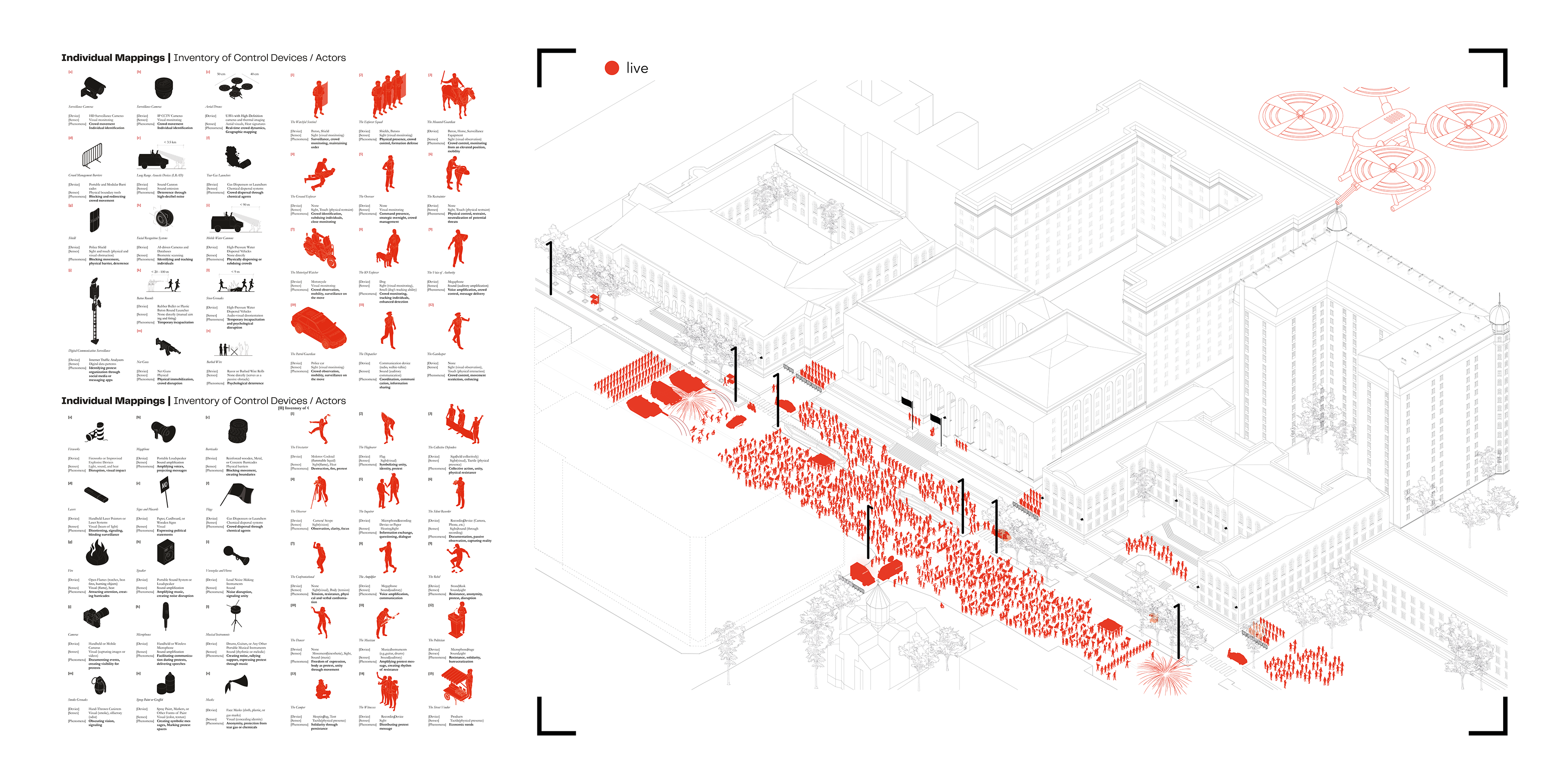
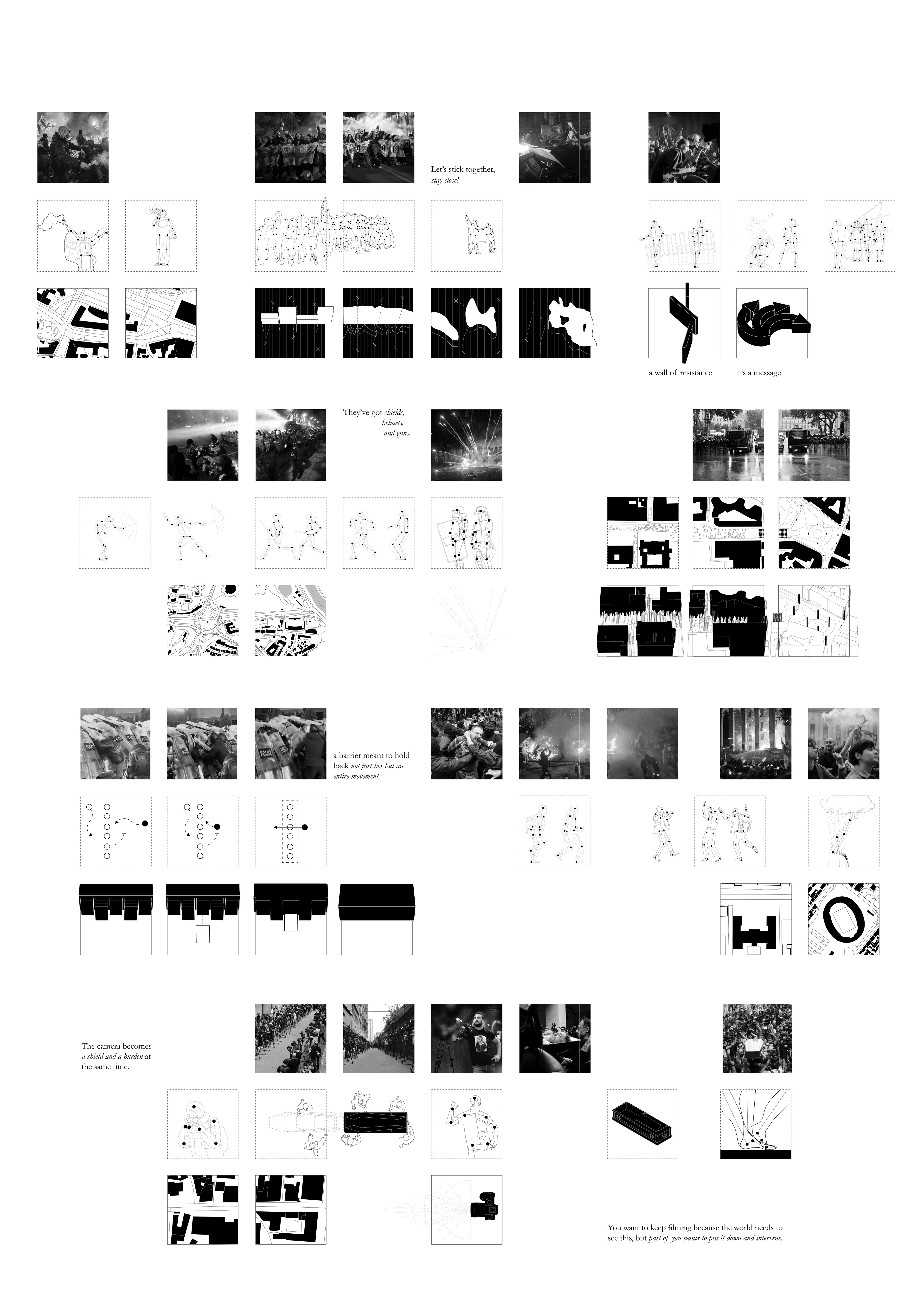
Image (Above): Dynamic Constellations / Ignition, Current, Dispersion, and Echo
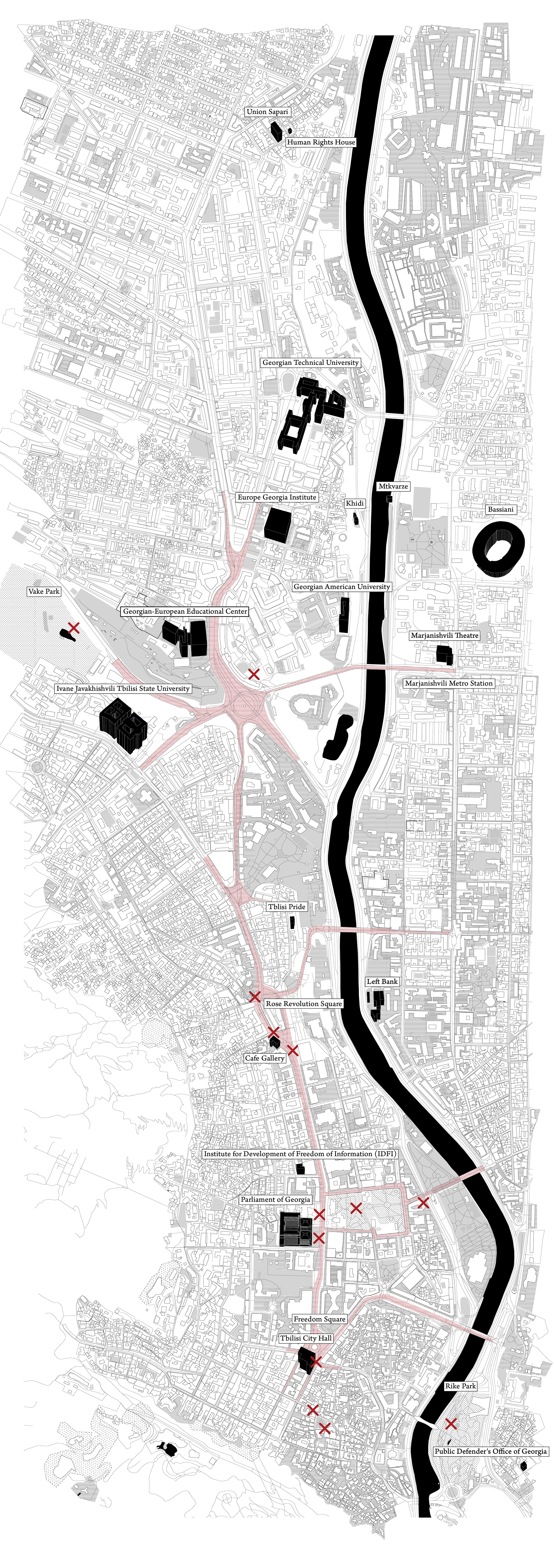
Image (Above): Spatialization of opposing forces in Tblisi
Library
The library operates not merely as a container of knowledge, but as an architectural instrument calibrated toward disruption, ambiguity, and strategic protection. Its structural logic—reinforced shear walls enclosing a steel-framed atrium—establishes a spatial cadence akin to a labyrinth. This rhythmic sequencing produces an architecture of multiplicity and concealment: a space that extends an invitation while simultaneously permitting withdrawal, opacity, and anonymity.
Circulation is intentionally resistant to linear comprehension. Entry is plural, yet no single path promises certainty. Each threshold destabilizes orientation: the tunnel entrance masked behind a rotating door, the second-floor passage veiled in plain sight. For the uninitiated, these routes dissolve into architectural noise, subsumed within more legible trajectories of movement. But for those who know, the building reveals a counter-cartography—one in which hidden passages and subtle apertures enable parallel forms of navigation. Orientation becomes elective rather than imposed; exploration supersedes direction.
This spatial ambiguity becomes essential in contexts of dissent. It generates zones of pause, pockets of withdrawal, moments of directional recalibration that resist surveillance and prediction. Nothing aligns perfectly—purposefully so. Risers shift in dimension; one corridor quickens the body while another slows it; what appears to be a perfect circle fractures upon closer inspection. These geometric disruptions unsettle habitual expectations of order and symmetry, mirroring the volatility of public space under conditions of unrest. What is typically presumed—clarity, stability, legibility—is gently but decisively displaced.
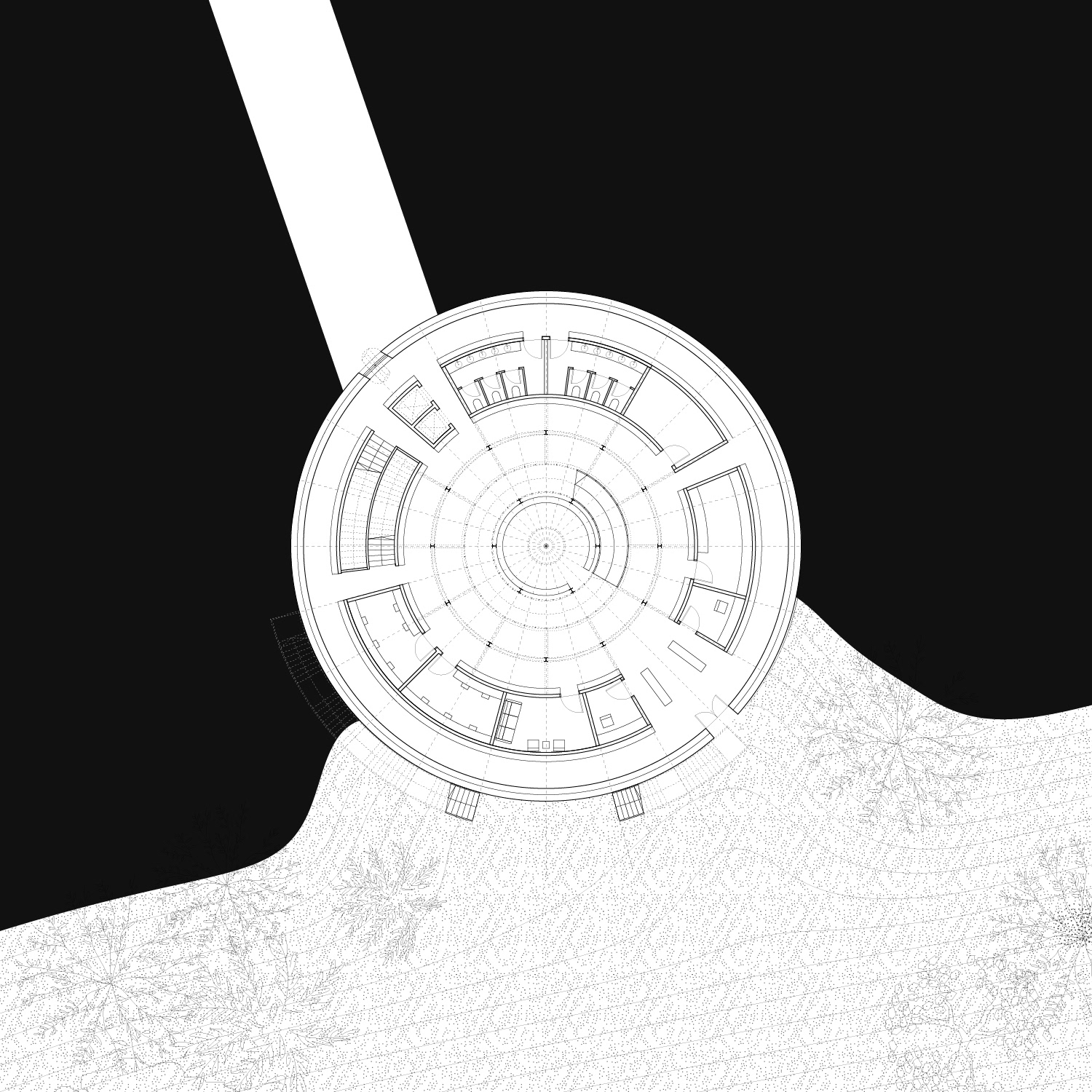
Image (Above): Library ground floor plan
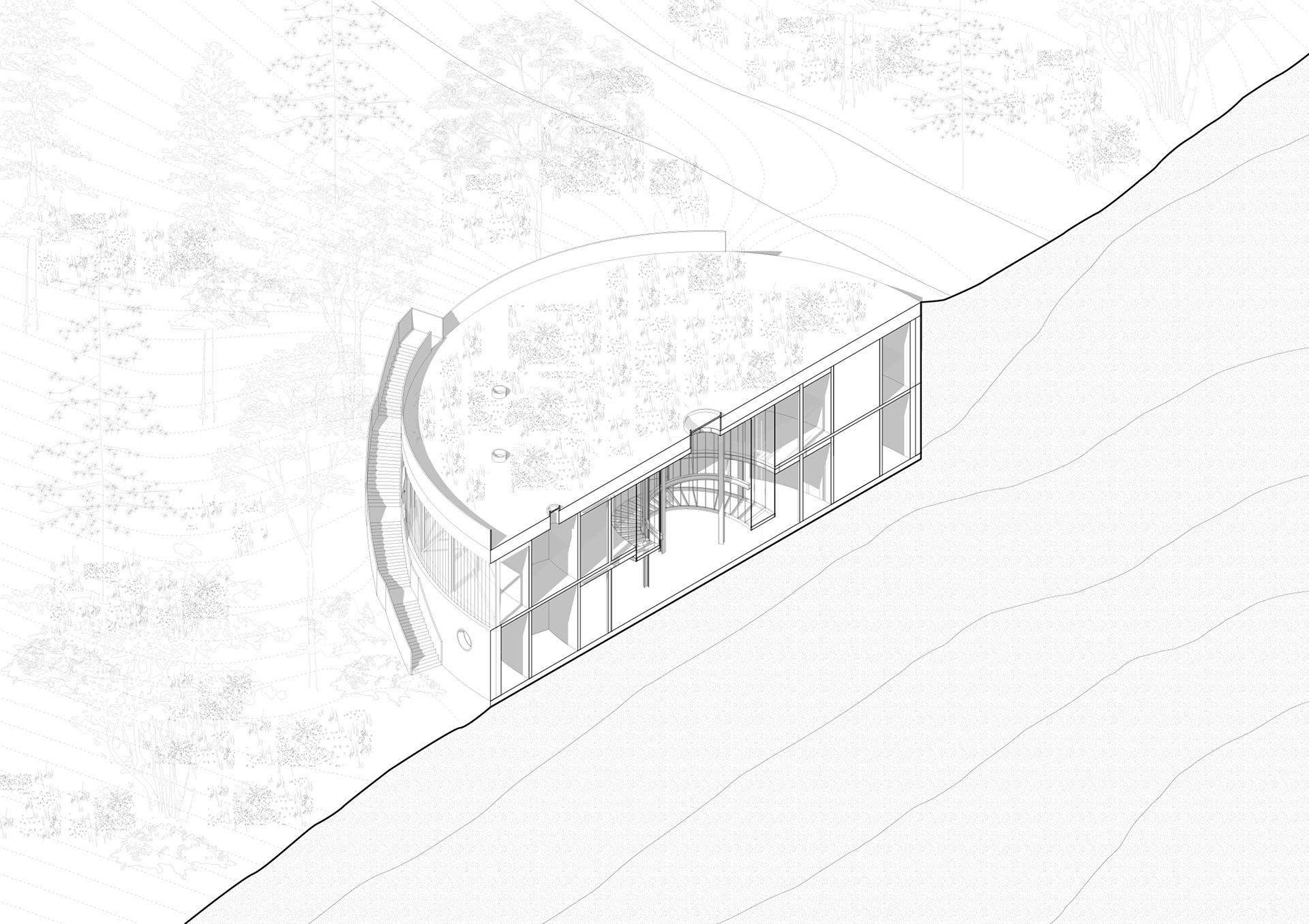
Image (Above): An isometric sectional perspective of the library, illustrating the spatial organization, structural hierarchy, and the relationship between the steel framework, concrete shear walls, and suspended circulation elements
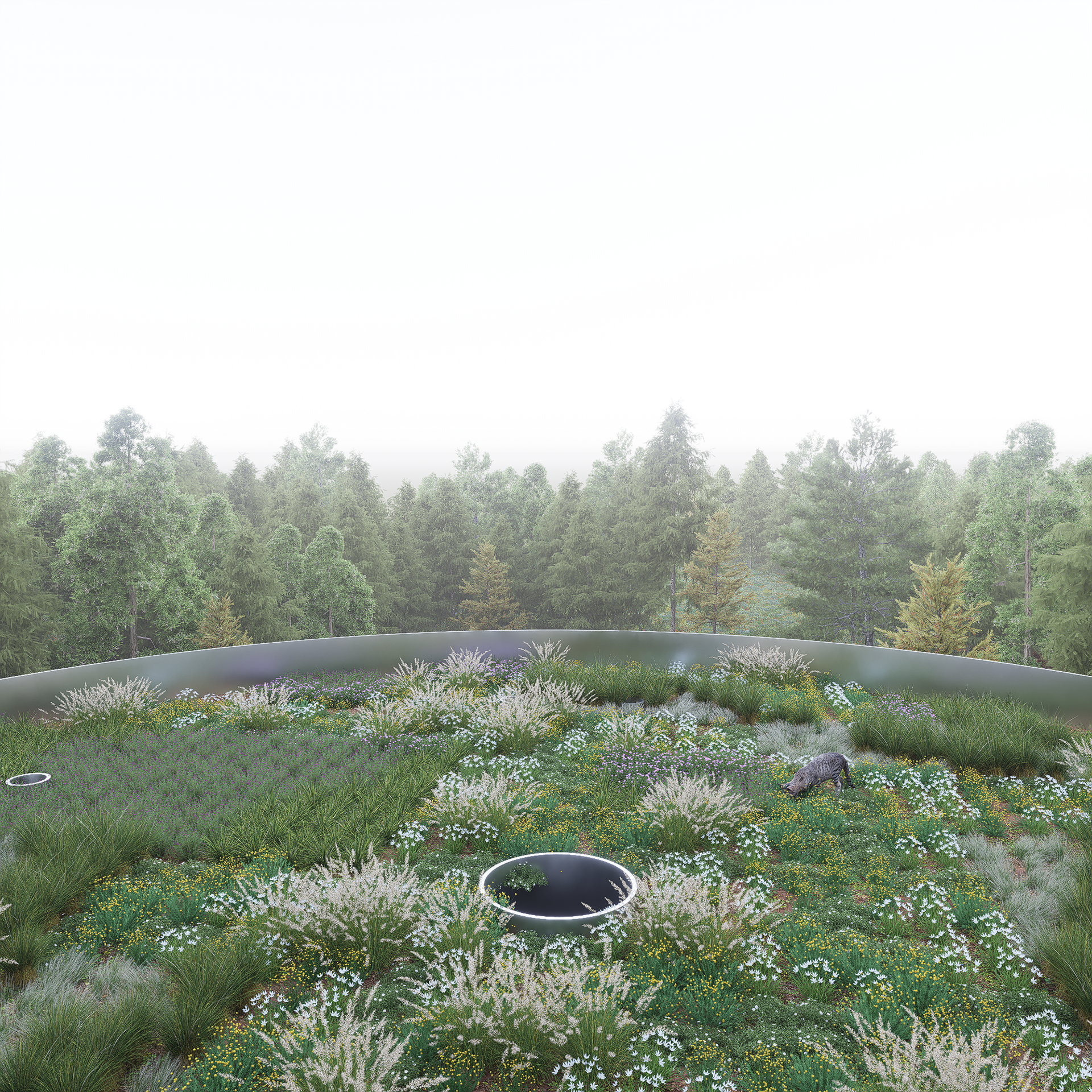
Image(Above): A view into the green roof the library connecting the upper and lower parts of the April 9 Park
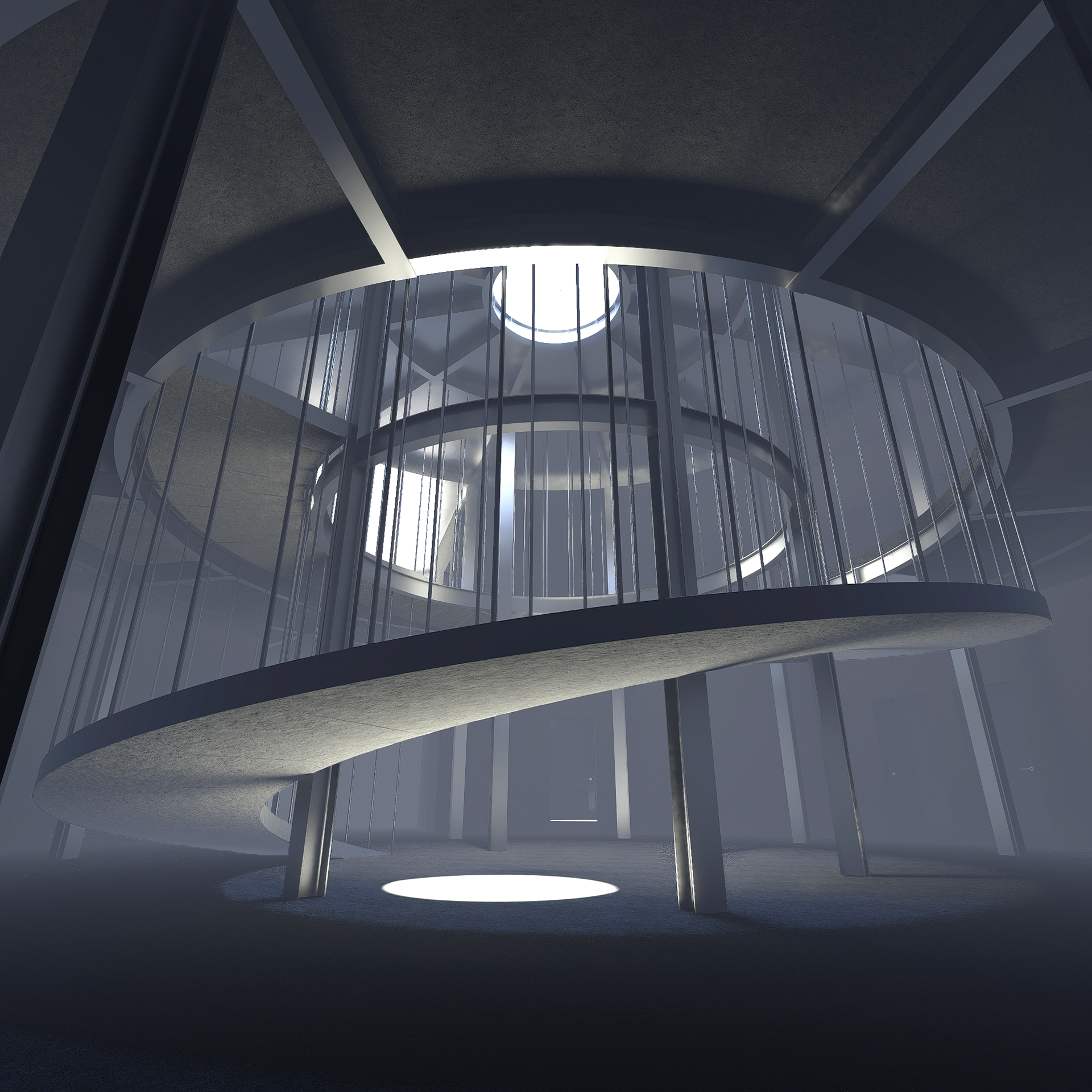
Image(Above): A view into the steel suspended atrium
Underground Club
The underground club is conceived as an architectural homage to the raw, subversive energies that define Tbilisi’s underground scene. Rather than imposing new materials or smoothing over the existing terrain, the design embraces the limestone strata discovered beneath April 9 Park. Its presence is neither masked nor domesticated; instead, the stone is left exposed, allowing the geology of the site to assume an active architectural role. Limestone’s inherent thermal mass—its capacity to absorb heat by day and release it gradually at night—creates a naturally moderated interior climate. More importantly, its exposure sustains an unmediated dialogue between the architecture and the earth from which it emerges.
The club embodies Foucault’s idea of heterotopia—existing both within and against the city through concealment, layered thresholds, and alternate modes of access. The architecture leverages this duality to unsettle familiar spatial orders, becoming not just a venue but a sanctuary for anonymity, intensity, and collective resistance.
Circulation is choreographed as a fragmented and multi-layered sequence. Movement does not follow the hierarchy of a singular staircase or central spine; instead, visitors traverse the architecture obliquely—threading through structural trusses, slipping behind walls, and descending into interstitial shadows. Such spatial logic aligns with the ethos of underground culture itself: distributed, non-linear, and deliberately unpredictable. Orientation is less a matter of precision than of attunement, a negotiation between body and space.
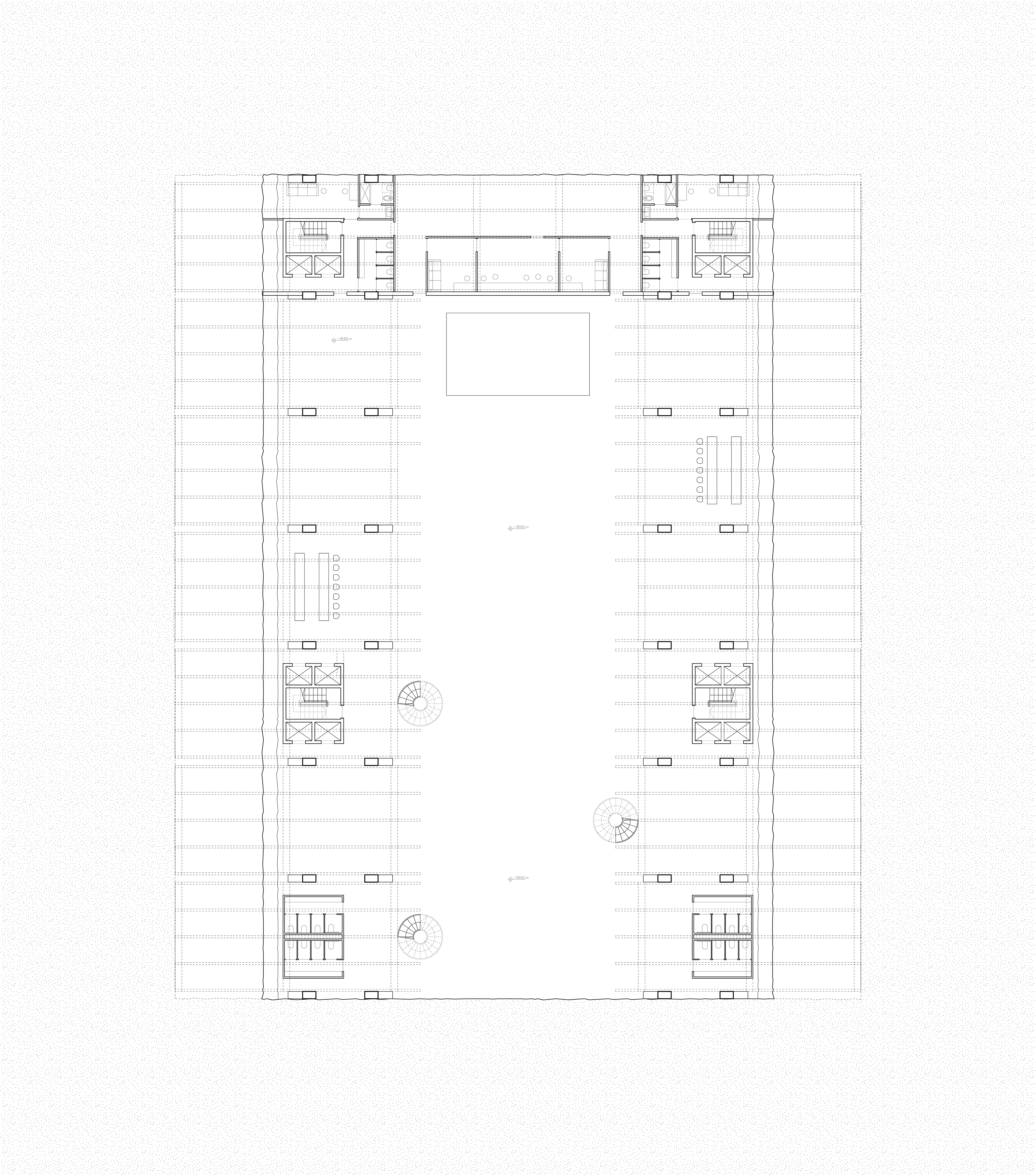
Underground club ground floor plan
Underground Club
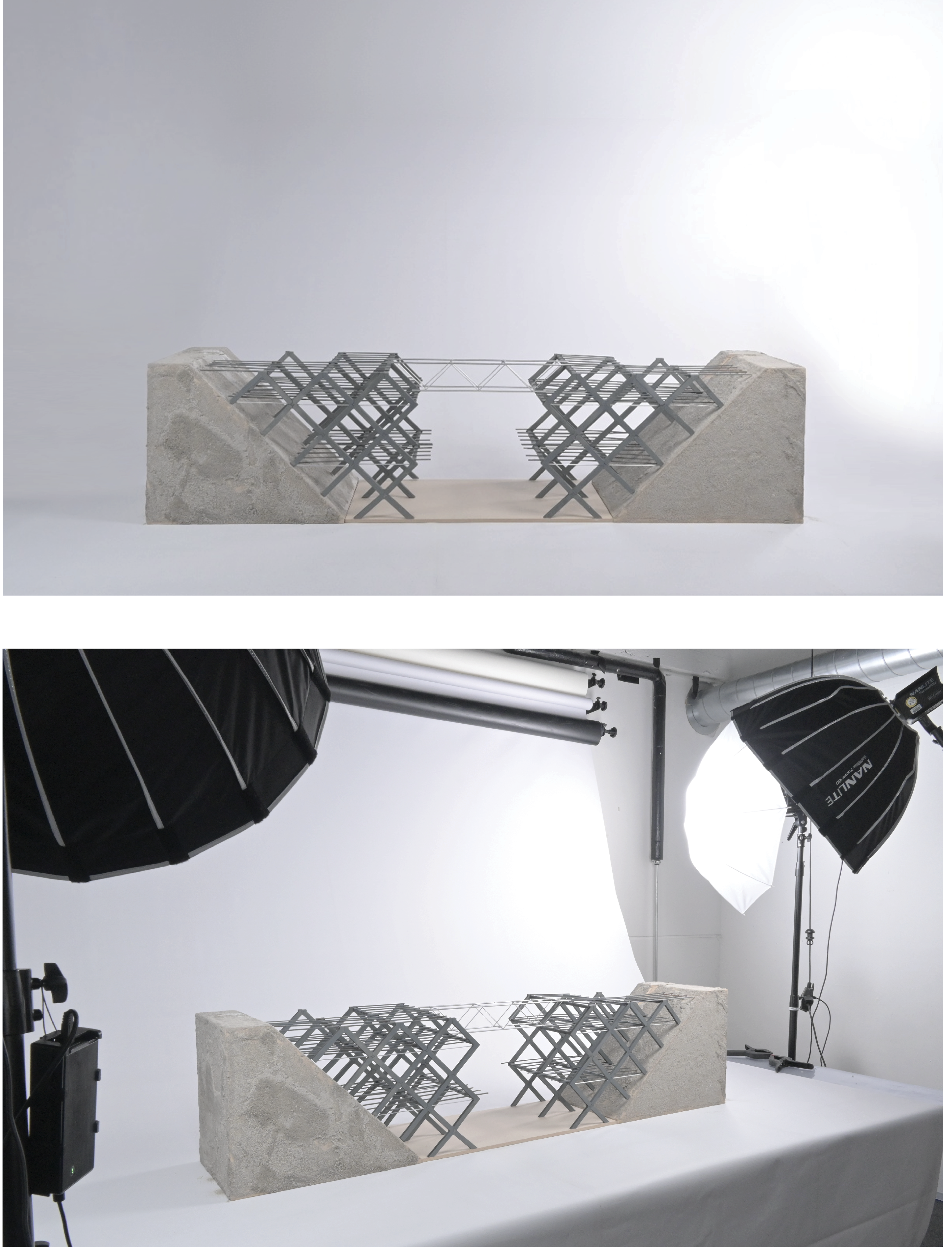
1:50 Physical
The structural concept draws inspiration from the modular logic of Wageningen University and Research Centre, unfolding through a hierarchy of prefabricated concrete beams and columns that establish a self-stable primary module. As this module repeats, secondary beams and steel tensioners extend the system and stabilize it, while overhead steel trusses support bridges and horizontal connections between units. Vertical cores are then introduced to anchor the structure, provide circulation, and enhance lateral stiffness. Slabs, spiral staircases, and utility volumes are layered into this framework, and the assembly culminates with a roof and skylight that bind the modules into a coherent architectural system.
This structural logic translates into a spatial experience defined by ordered repetition and calibrated variation. Each module becomes both a discrete spatial unit and part of a larger, rhythmic continuum. Visible joints, seams, and intersections articulate subtle thresholds, marking shifts in orientation and scale. As one moves through the building, spaces unfold horizontally and vertically in a sequence shaped by the cadence of the structural grid, producing an environment where modularity becomes both the framework and the experiential language of the architecture.
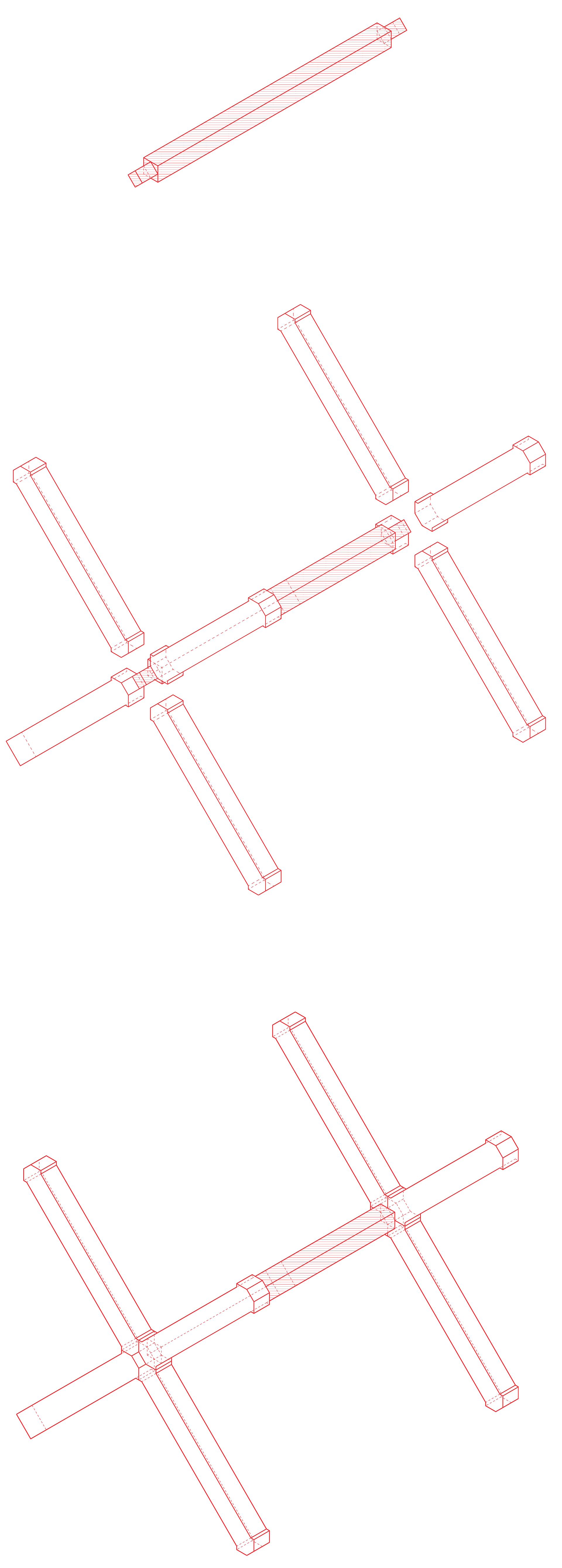
Images (Above): Prefabricated reinforced concrete columns are joined with customized beams, ensuring precise assembly while enhancing structural efficiency
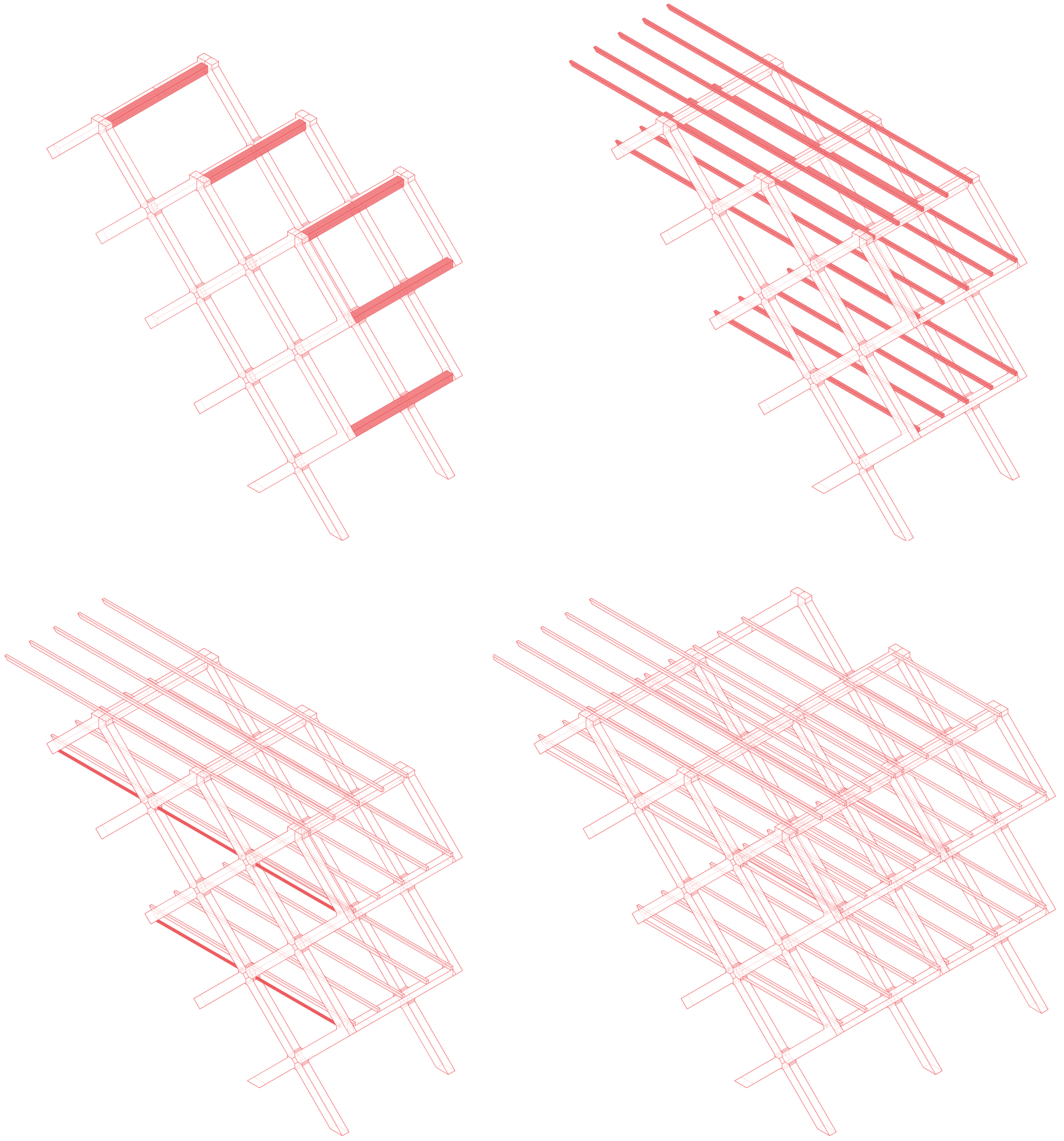
Image (Above-Left): A detailed view highlighting the customized reinforced concrete beams within a module, showcasing their structural role and design
Image (Above-Right): Secondary reinforced concrete beams are integrated into the module, enhancing structural support and reinforcing the system’s overall coherence
Image (Below-Left): Steel tensioners are introduced at the junctions of the reinforced concrete columns, providing additional stability and reinforcing the structural integrity of the systemImage Image (Below-Right): The second module is added to the system, extending the structural logic and reinforcing the modular rhythm of the overall design
Image (Above-Right): Secondary reinforced concrete beams are integrated into the module, enhancing structural support and reinforcing the system’s overall coherence
Image (Below-Left): Steel tensioners are introduced at the junctions of the reinforced concrete columns, providing additional stability and reinforcing the structural integrity of the systemImage Image (Below-Right): The second module is added to the system, extending the structural logic and reinforcing the modular rhythm of the overall design
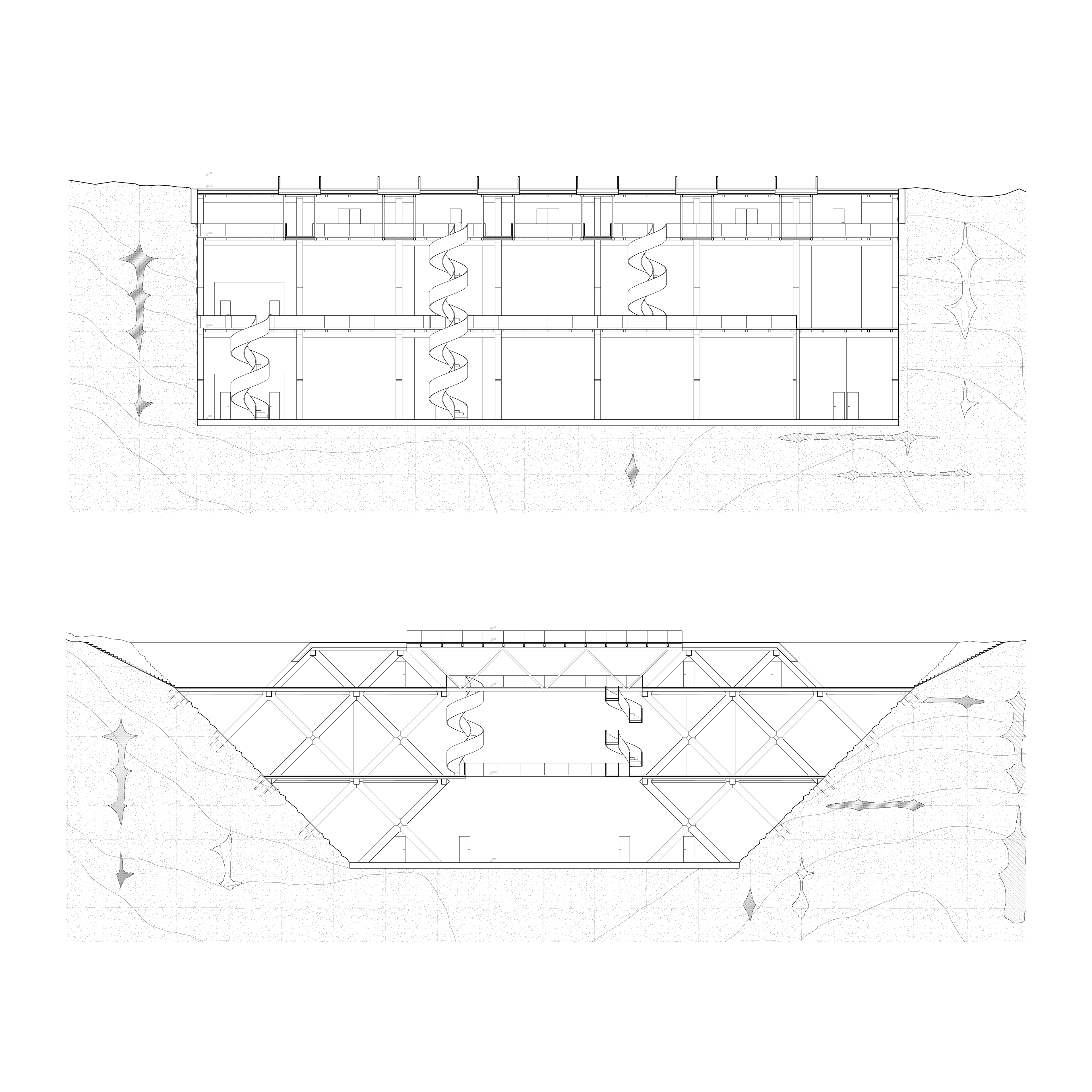
Image (Above): Section A-A of the Underground Club
Image (Below): Section B-B of the Underground Club
Image (Below): Section B-B of the Underground Club
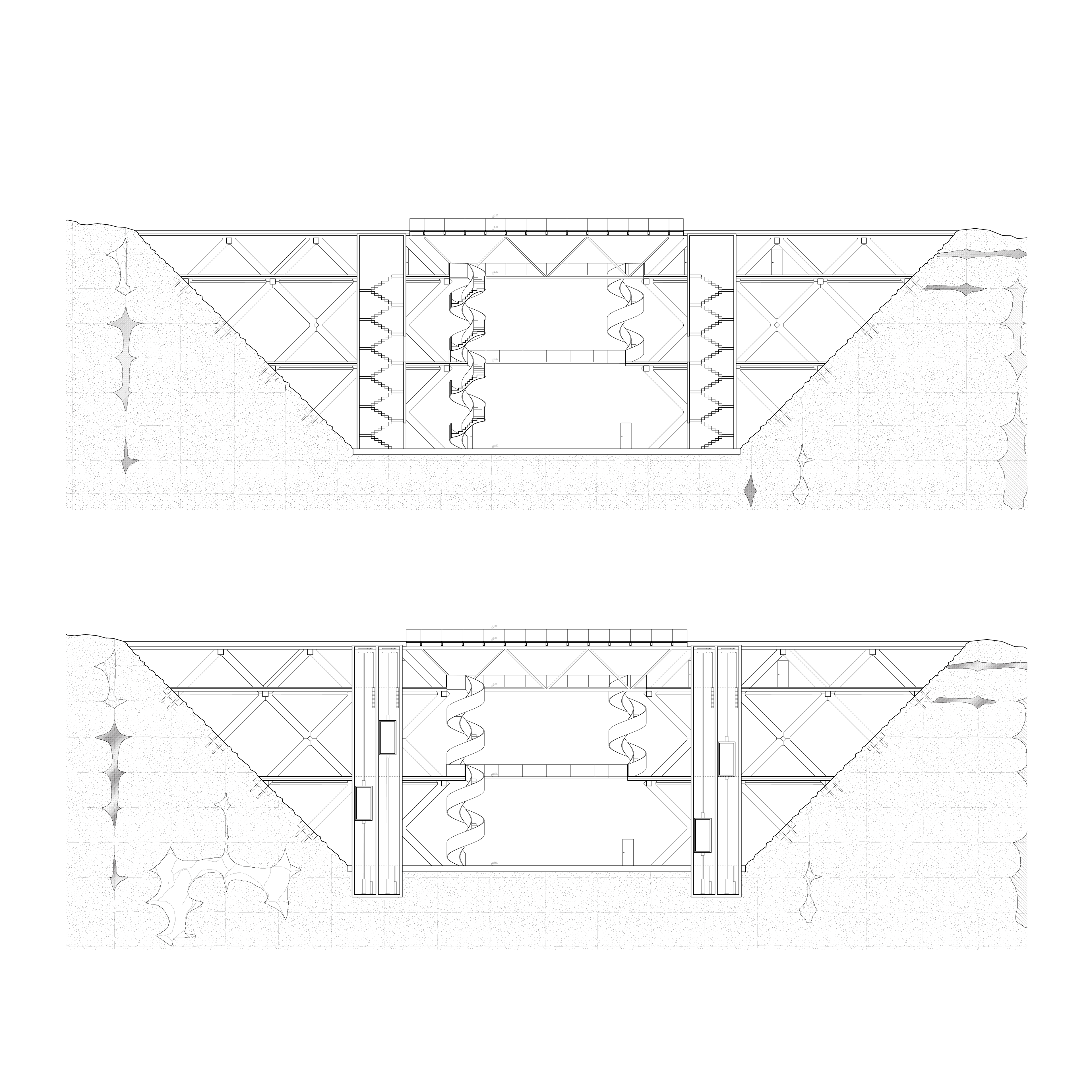
Image (Above): Section C-C of the Underground Club
Image (Below): Section D-D of the Underground Club
Image (Below): Section D-D of the Underground Club
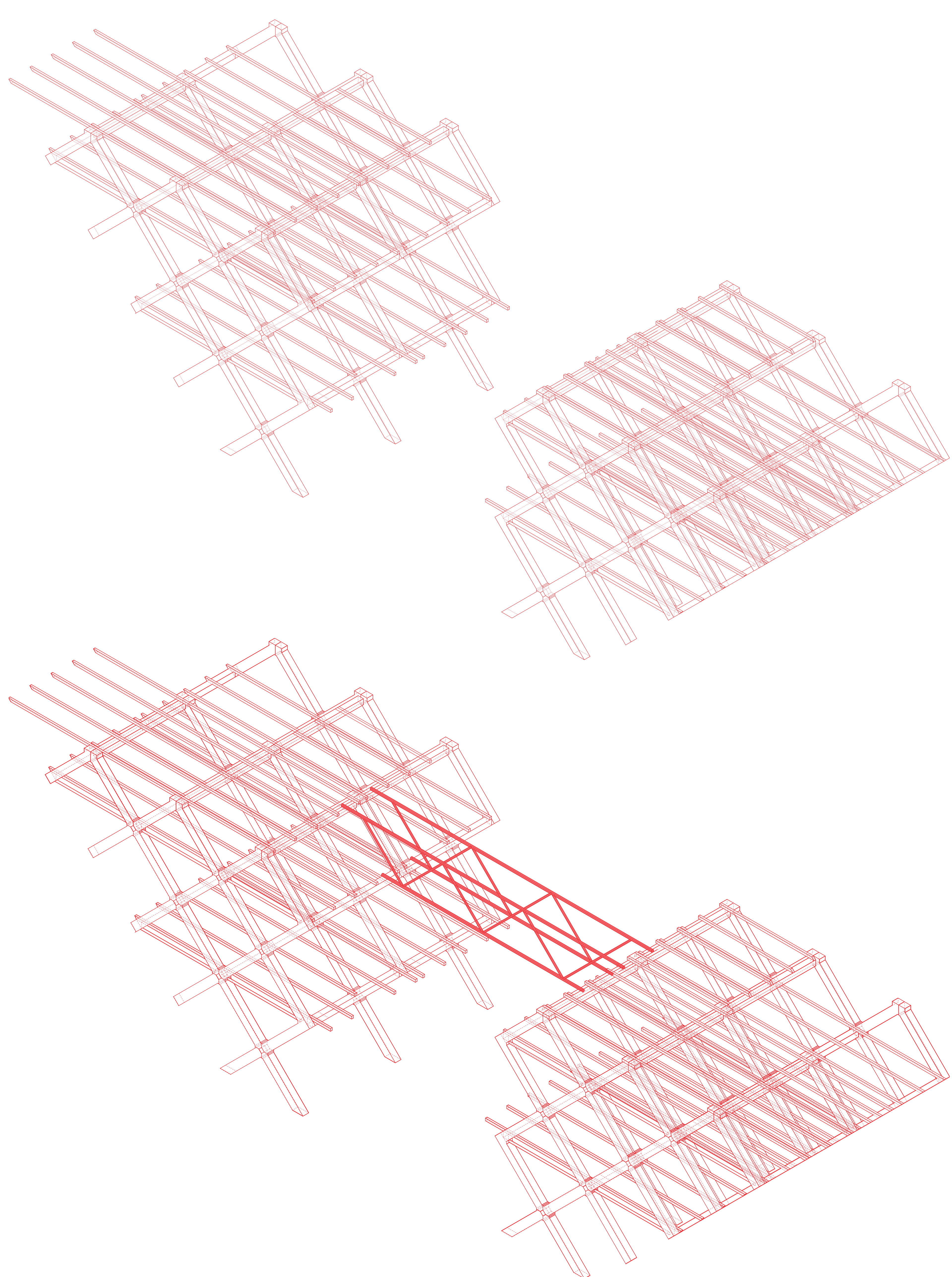
Image (Above): The second module is integrated into the system, reinforcing the underlying logic of the structural framework and establishing a rhythmic, repeatable order
Image (Below): A steel truss system is introduced to support the bridges above, enabling long-span connectivity while contributing to the structural clarity and tectonic expression of the design
Image (Below): A steel truss system is introduced to support the bridges above, enabling long-span connectivity while contributing to the structural clarity and tectonic expression of the design
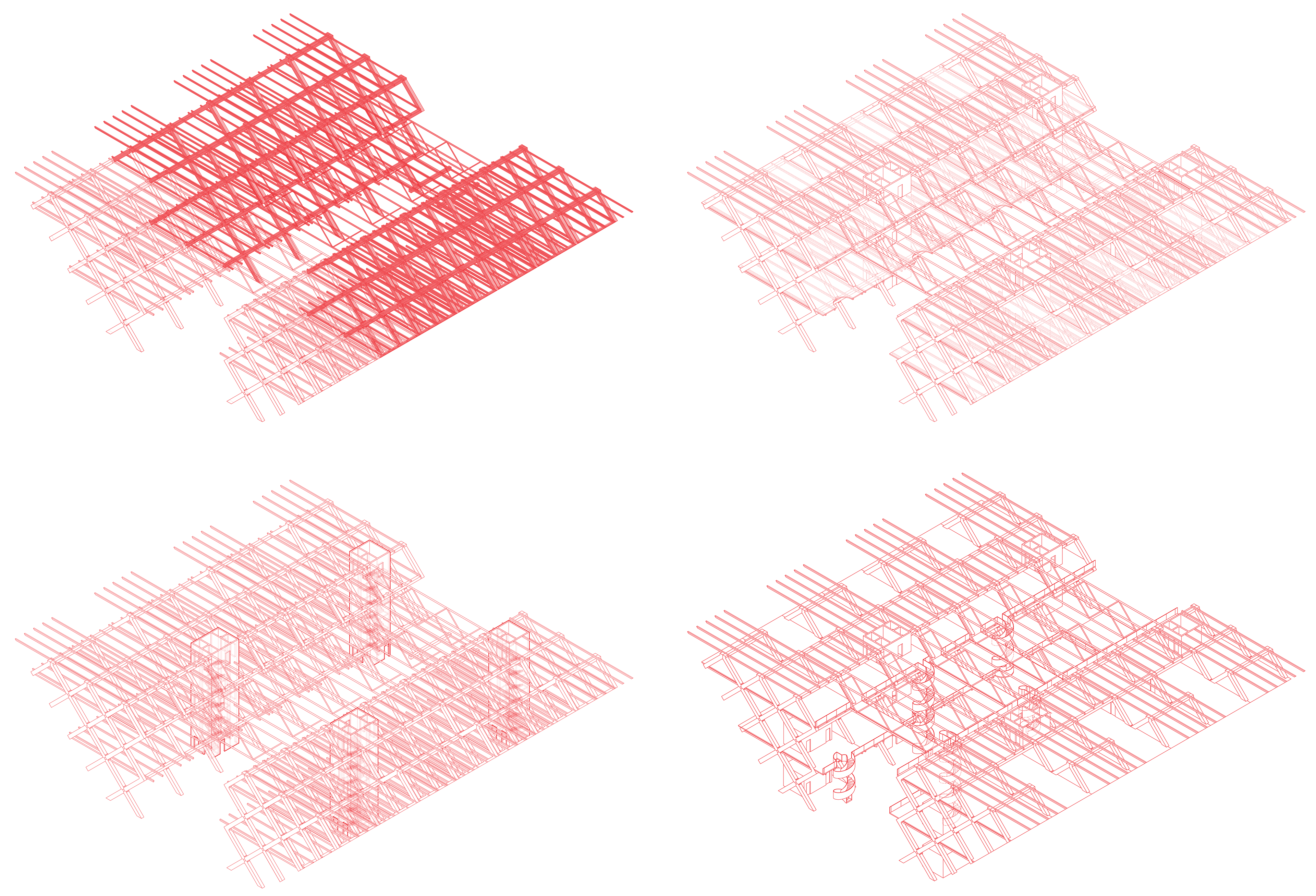
Image (Above-Left): The remaining structure is realized through the systematic repetition of a modular unit, reinforcing spatial rhythm, construction efficiency, and formal coherence
Image (Below-Left): Circulation cores are incorporated to facilitate vertical movement while simultaneously enhancing the structure’s lateral stability
Image (Above-Right): The slabs are integrated alongside the truss connections, establishing both structural continuity and spatial cohesion within the overall architectural framework
Image (Below-Right): Spiral staircases and utility volumes are strategically introduced into the system, facilitating vertical circulation and functional efficiency while reinforcing the spatial hierarchy of the design
Image (Below-Left): Circulation cores are incorporated to facilitate vertical movement while simultaneously enhancing the structure’s lateral stability
Image (Above-Right): The slabs are integrated alongside the truss connections, establishing both structural continuity and spatial cohesion within the overall architectural framework
Image (Below-Right): Spiral staircases and utility volumes are strategically introduced into the system, facilitating vertical circulation and functional efficiency while reinforcing the spatial hierarchy of the design
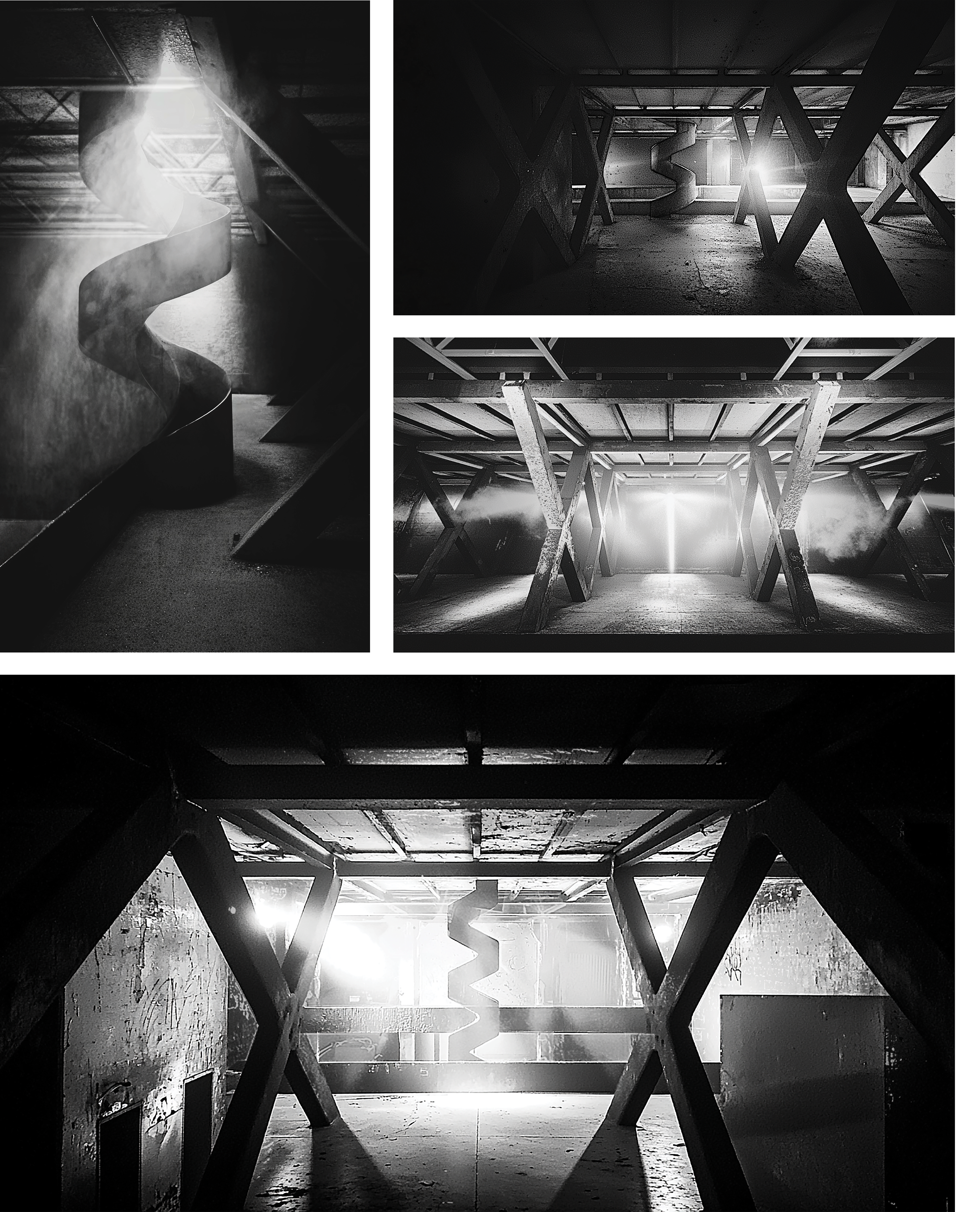
Image (Left): A view of the spiral staircase spanning from ground to top floor, highlighting its vertical continuity and sculptural form
Image (Above-Right): An interior perspective capturing the dynamic flow of one of the spiral staircase circulations
Image (Below-Right): An interior perspective highlighting the spatial definition and structural rhythm established by the X-shaped columns
Image (Below): An interior perspective capturing the dynamic flow of one of the spiral staircase circulations
Image (Above-Right): An interior perspective capturing the dynamic flow of one of the spiral staircase circulations
Image (Below-Right): An interior perspective highlighting the spatial definition and structural rhythm established by the X-shaped columns
Image (Below): An interior perspective capturing the dynamic flow of one of the spiral staircase circulations
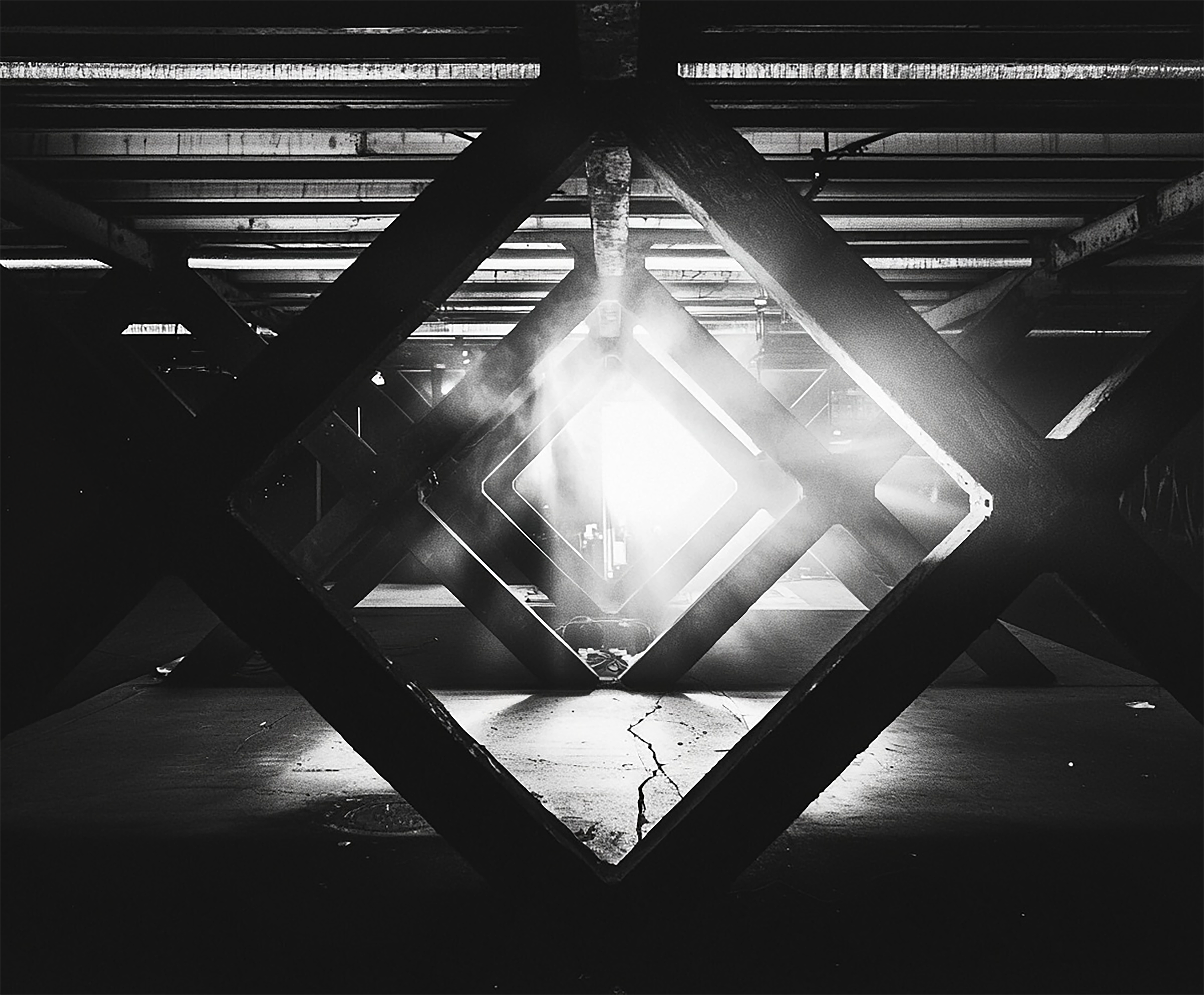
A frontal view of aligned X-shaped frames, creating a layered geometric corridor with light emphasizing symmetry and structural clarity
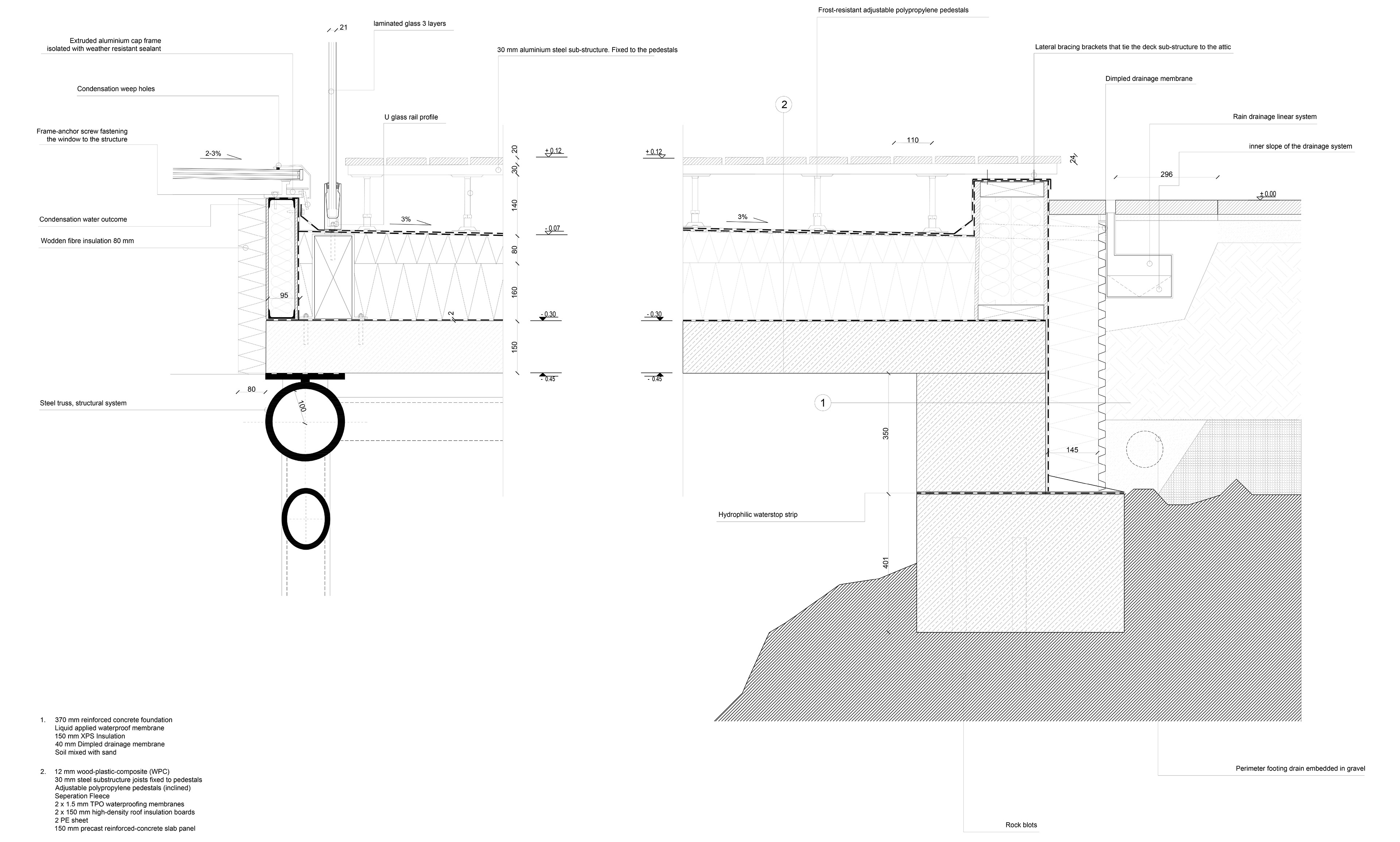
Image (Left): A 1/5 detailed section showcasing the close-up of the connection between the structural trusses, skylight, and the roof structure
Image (Right): A 1/5 detailed section showcasing the close-up of the connection between the roof structure and the underground limestone
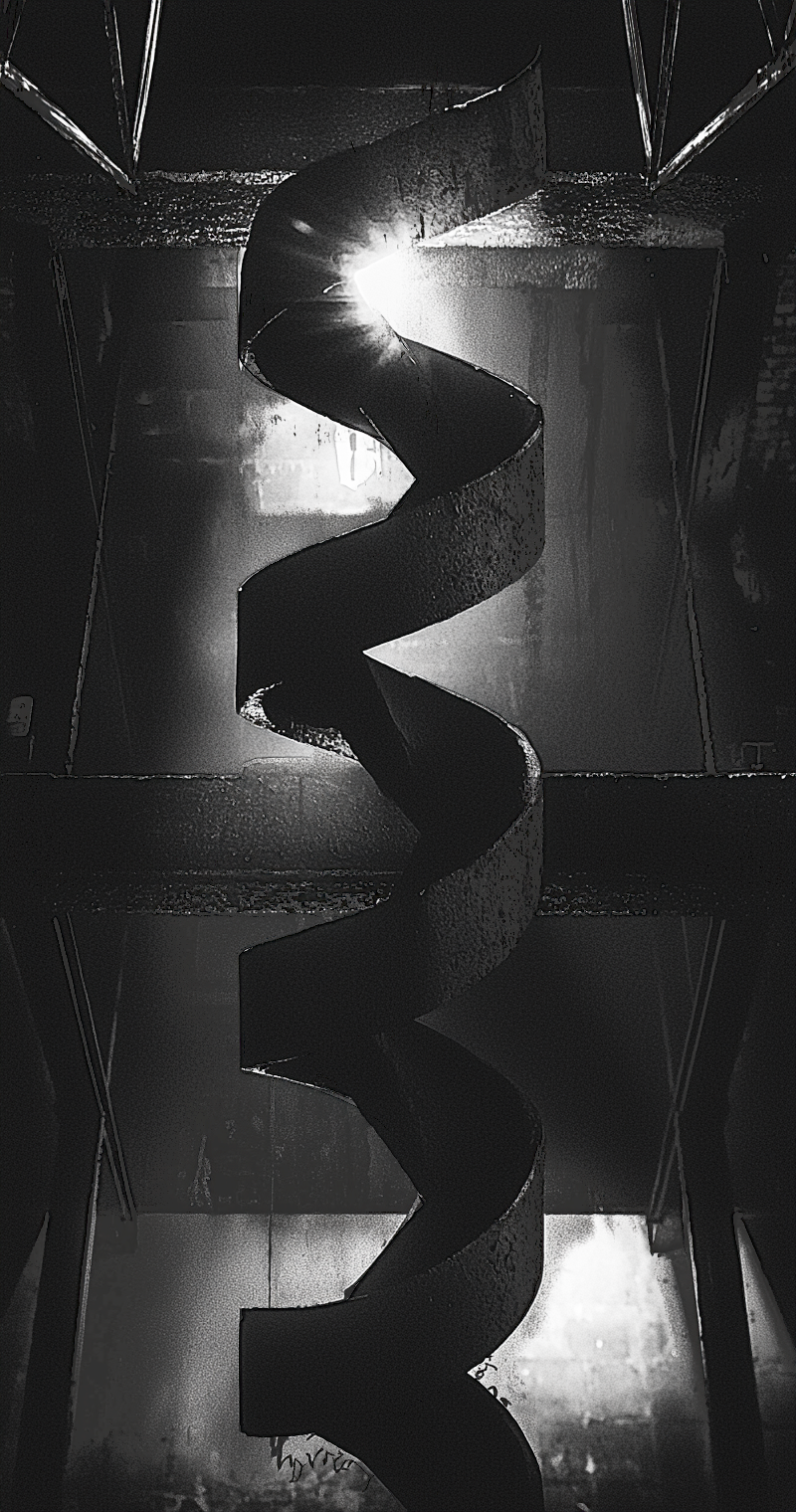
Image (Above): A view of the spiral staircase spanning from ground to top floor, highlighting its vertical continuity and sculptural form
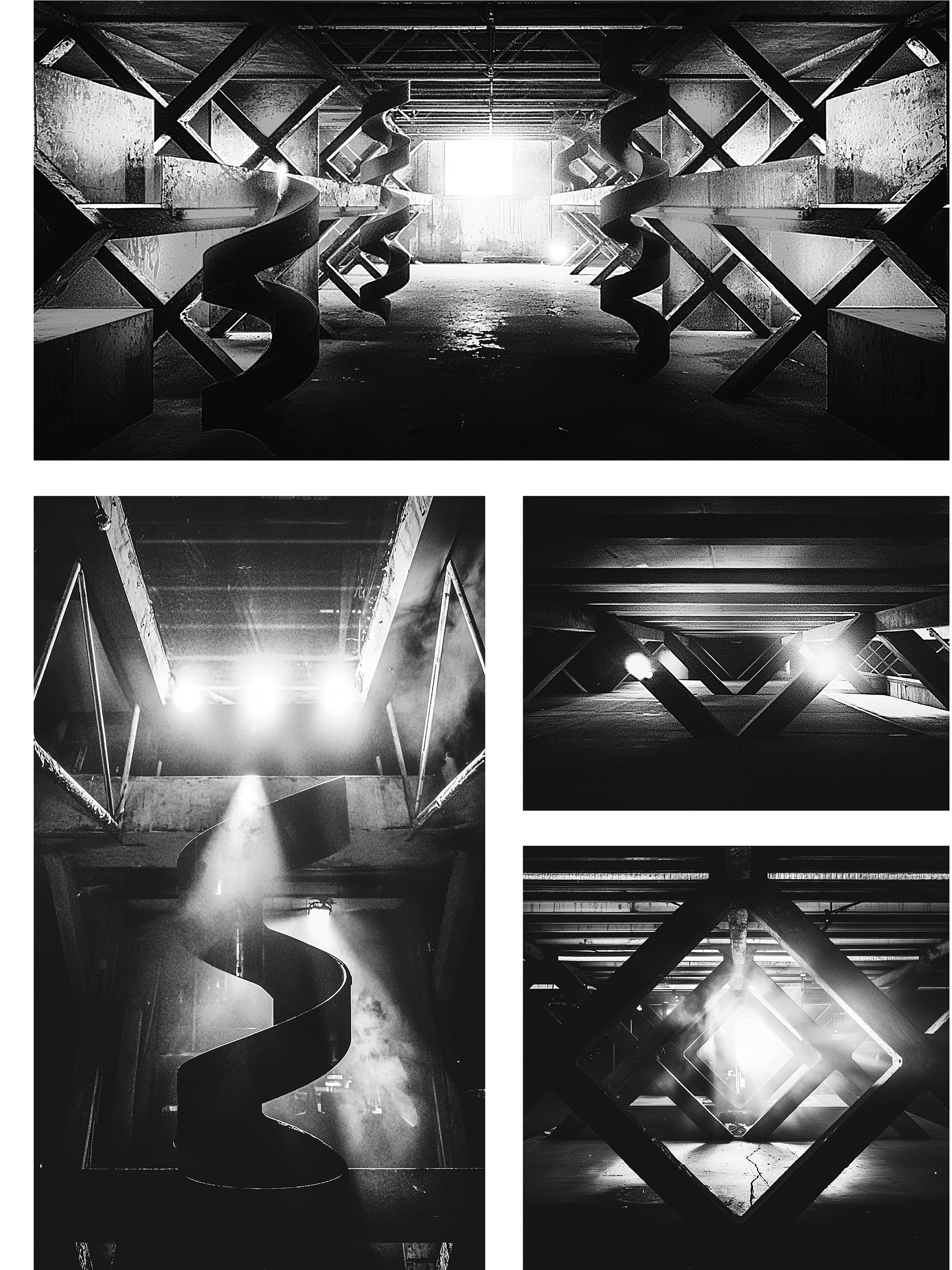
Image (Left): A dramatic interior view featuring a sculptural spiral staircase, with directional light emphasizing vertical circulation and the raw structural framework
Image (Right-Above): A low-angle shot highlighting the continuence of X-shaped columns, where light and shadow accentuate the depth and rhythm of the structural system
Image (Right-Below): A frontal view of aligned X-shaped frames, creating a layered geometric corridor with light emphasizing symmetry and structural clarity
Image (Below): An interior perspective highlighting the spatial experience from the first floor
Image (Right-Above): A low-angle shot highlighting the continuence of X-shaped columns, where light and shadow accentuate the depth and rhythm of the structural system
Image (Right-Below): A frontal view of aligned X-shaped frames, creating a layered geometric corridor with light emphasizing symmetry and structural clarity
Image (Below): An interior perspective highlighting the spatial experience from the first floor
Exhibition Hall
The exhibition hall operates simultaneously as an archive and a field of active navigation—a spatial terrain where protest culture, artistic resistance, and collective memory are encountered, interpreted, and re-formed. Unlike the project’s other programs, which emphasize learning and embodiment, this space centers on exposure, narration, and the dynamic act of reading spatialized histories. At its core sits a vertical anchor: a functional and symbolic element that houses circulation and utilities while providing a stable point of reference within an otherwise shifting environment. Once visitors step beyond it, the spatial logic fractures—each floor reorganizes itself like a maze, disorienting movement while keeping the core visibly constant.
Partition walls serve not only as surfaces for displaying protest material but as agents that sculpt the internal landscape. They become hiding walls, dead-ends, misdirections, or temporary refuges. Their placement responds to the rhythm of the waffle slab above, whose grid governs shifts in direction and cadence; where the structural logic bends, the maze folds, dissolves, or renews itself. This interplay between overhead structure and ground-level layout produces an interior that oscillates between coherence and unpredictability.
Vertical circulation reinforces this spatial ambiguity. The scissor stair configuration—shared by the hall’s circulation and the tunnel evacuation route—creates layered sightlines, split paths, and moments of visual confusion. Such destabilization echoes the experiential dissonance of civic unrest, where clarity and orientation are perpetually renegotiated. In this hall, nothing is entirely fixed; the space remains in continuous negotiation between visibility and retreat, narrative and fragmentation.
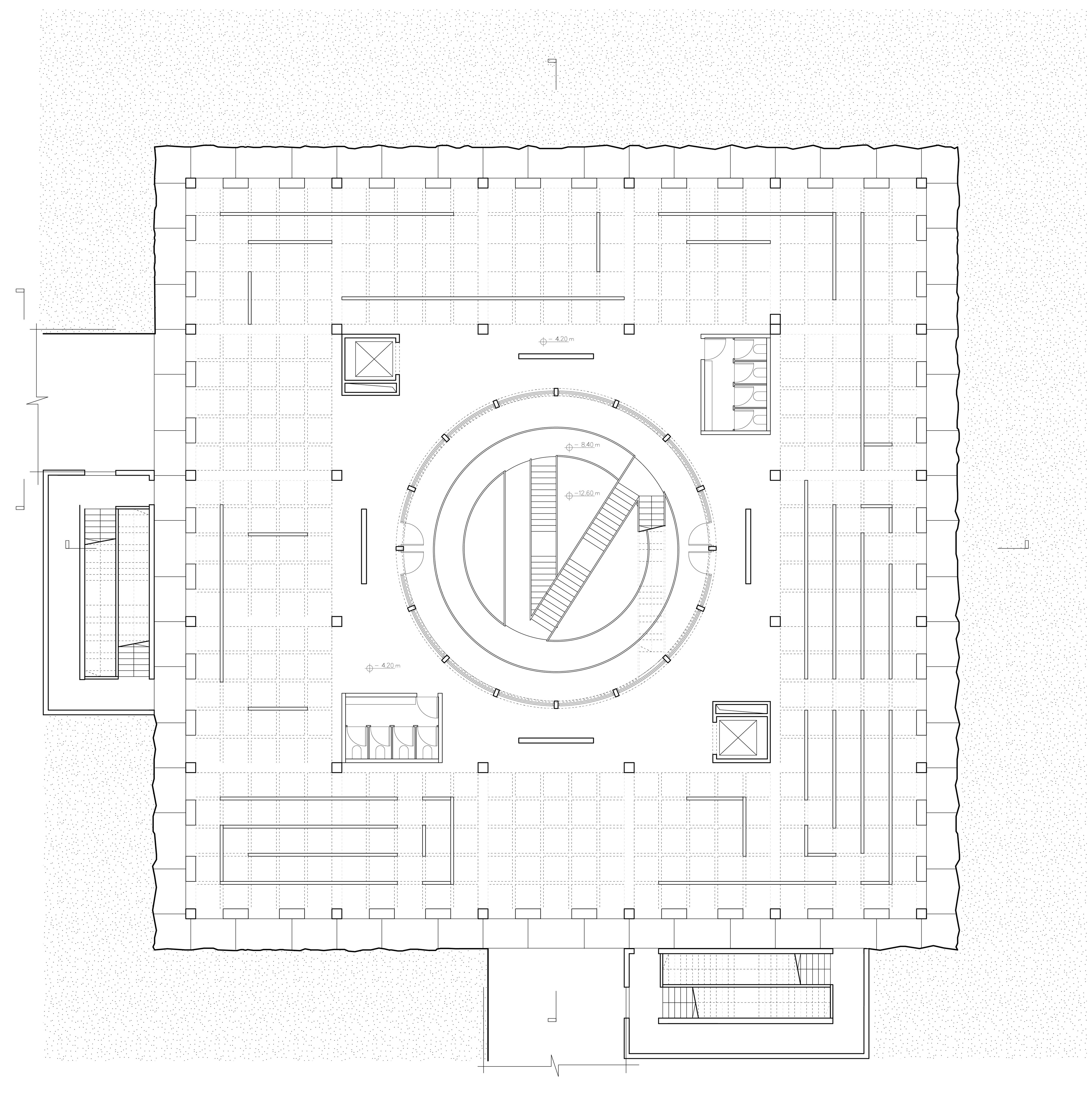
Image (Above): Third-floor plan of the exhibition hall
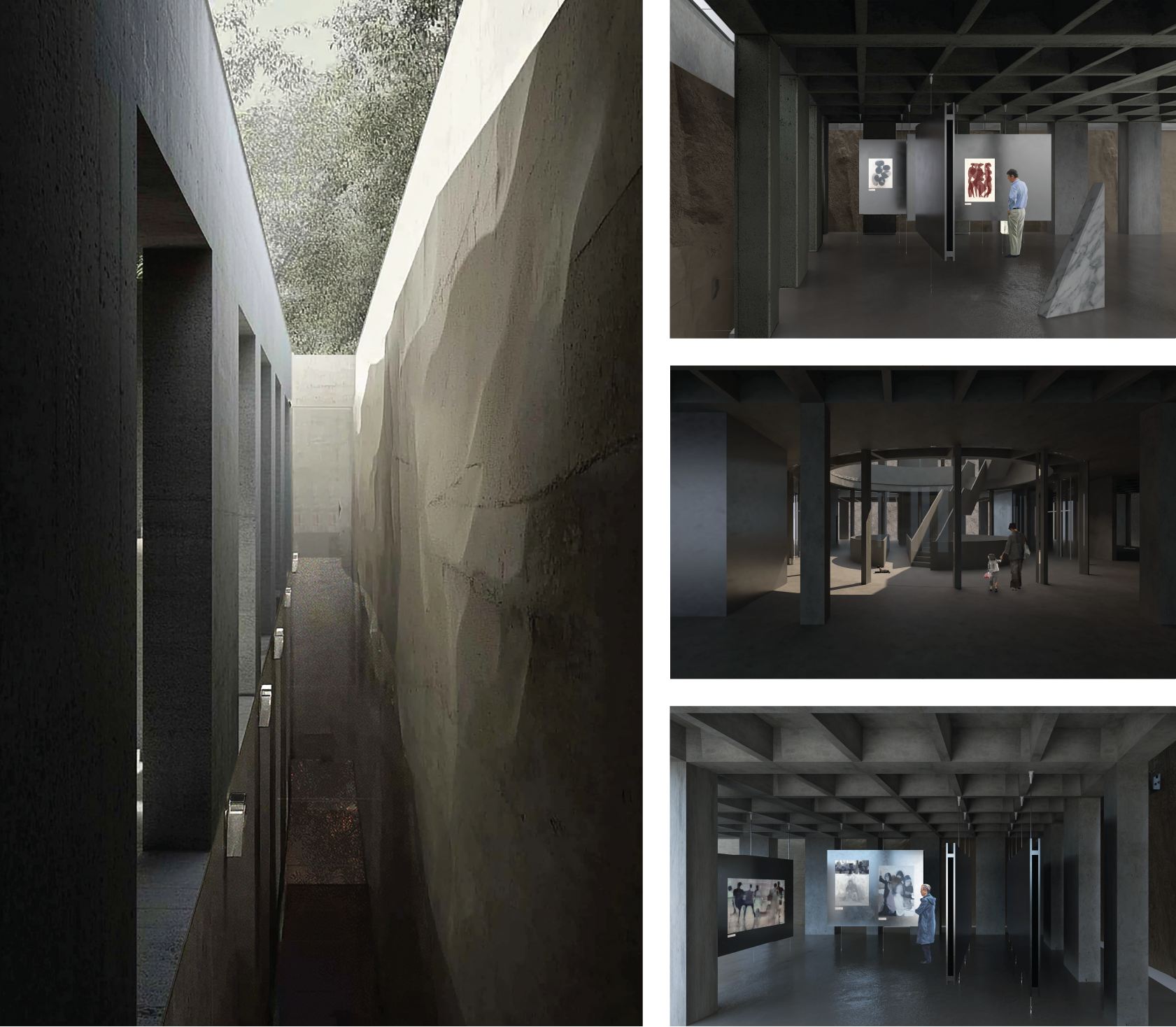
Image (Left): A perspective on the exhibition hall section that exemplifies the architectural strategy for harnessing natural light through overhead apertures
Image (Right-Above): A perspective view of the exhibition hall interior, showing how spatial separators shape circulation and concealment, while also highlighting the limestone detailing and the transformative effect of perimeter lighting on the spatial atmosphere
Image (Right-Middle): An elevated perspective overlooking the atrium structure, illustrating the spatial atmosphere from within while showcasing the architectural integration of natural light as it filters into the interior space
Image (Right-Below): A perspective view of the exhibition hall interior, showing how spatial separators shape circulation and create a maze-like environment
Image (Right-Above): A perspective view of the exhibition hall interior, showing how spatial separators shape circulation and concealment, while also highlighting the limestone detailing and the transformative effect of perimeter lighting on the spatial atmosphere
Image (Right-Middle): An elevated perspective overlooking the atrium structure, illustrating the spatial atmosphere from within while showcasing the architectural integration of natural light as it filters into the interior space
Image (Right-Below): A perspective view of the exhibition hall interior, showing how spatial separators shape circulation and create a maze-like environment
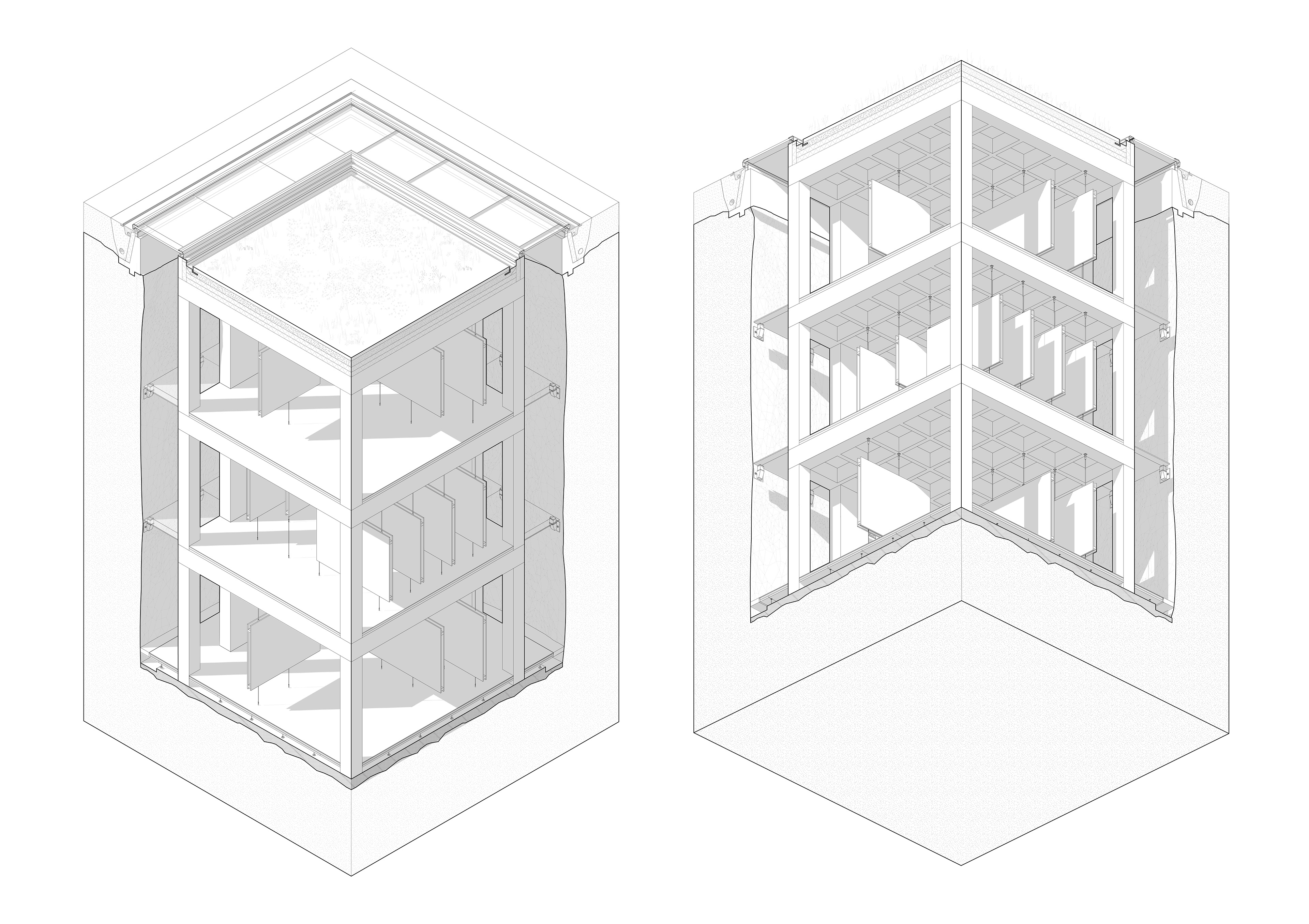
Image (Left): An isometric sectional drawing of the exhibition hall corner, clearly illustrating the integration of structural and aesthetic elements—where material articulation, construction logic, and spatial experience come together in a unified architectural composition
Image (Right): A Choisy-style sectional perspective of the exhibition hall corner, meticulously illustrating the convergence of structural and aesthetic elements—where materiality, construction logic, and spatial expression are seamlessly integrated into a cohesive architectural composition
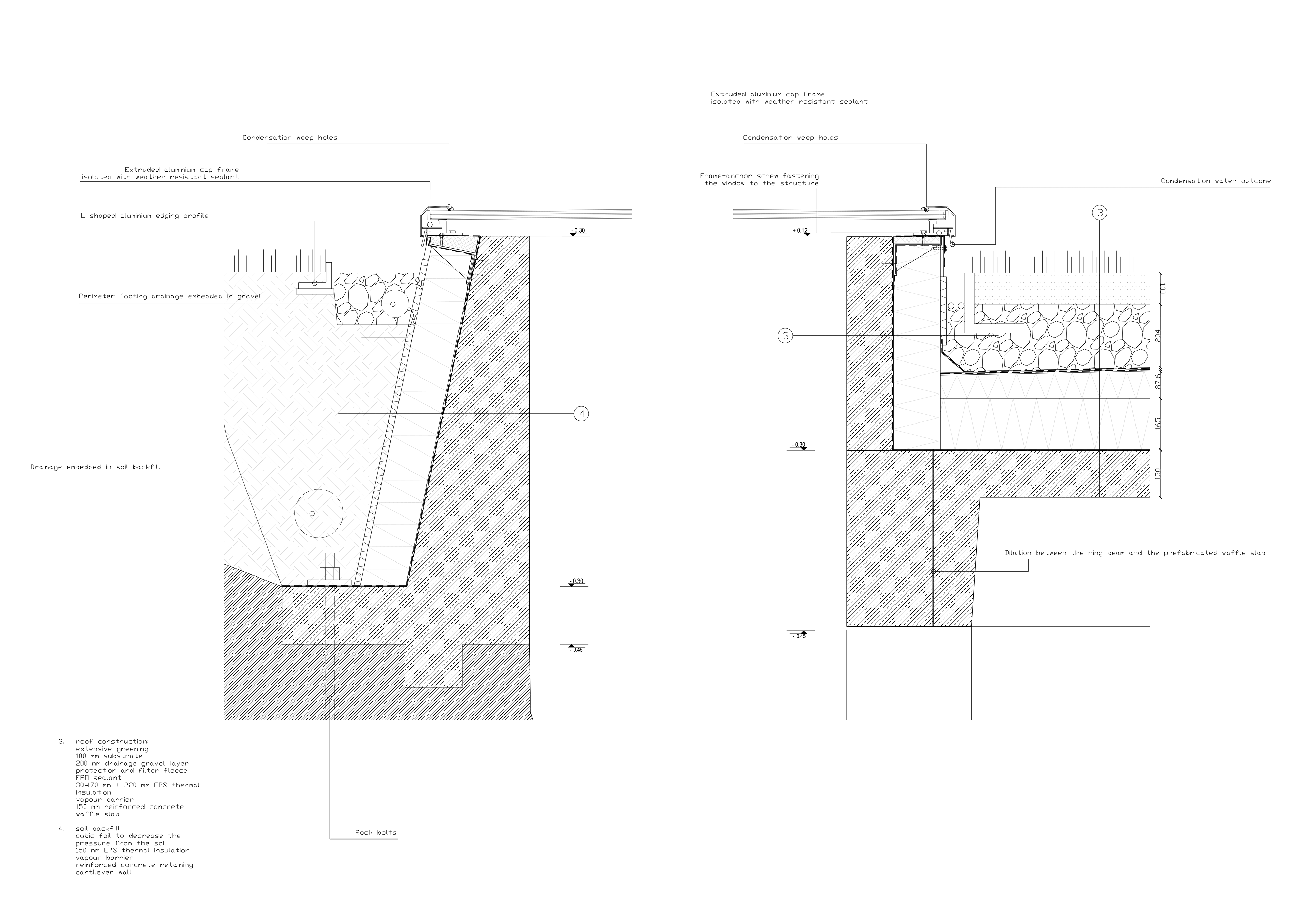
Image (Above): 1/5 Detailed section focusing on the connection of roof, skylight, and the ground
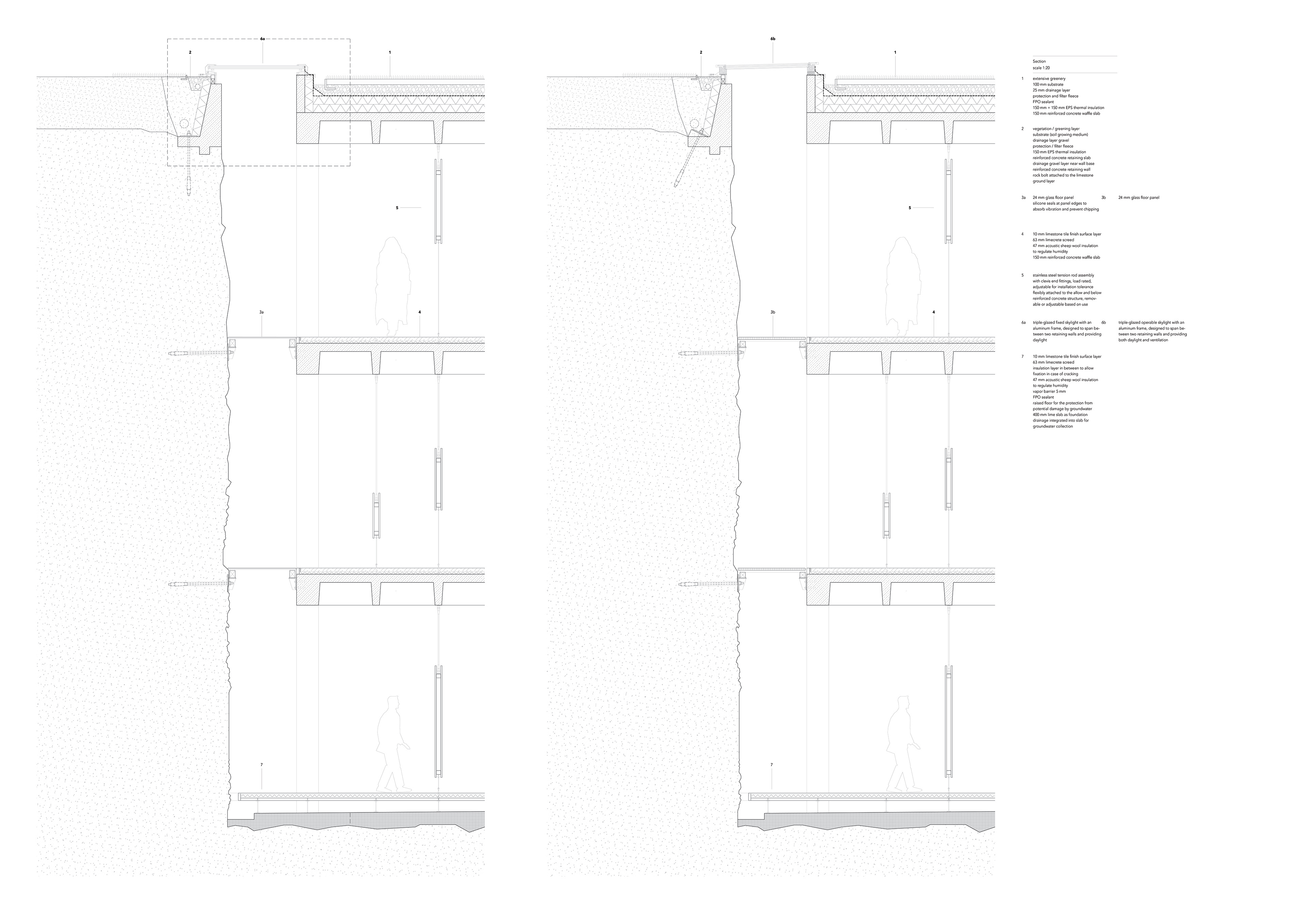
Image(Above): Detailed section of section of exhibition hall and its connection to the existing underground limestone demonstrating the strategy of ventilation and light
Underground Tunnels
The tunnels serve as the final link in the project’s spatial narrative: if the library functions as the repository of memory, and the club as its site of embodied experience, then the exhibition hall is where memory is revealed—through images, detours, and a deliberately fragmented choreography of movement. These subterranean connections translate the architectural program into a continuous spatial journey, blurring the boundaries between accumulation, performance, and revelation. The primary tunnels connecting the library and exhibition hall are excavated using a Tunnel Boring Machine (TBM), ensuring minimal disturbance to the surface environment and preserving the integrity of the surrounding terrain. In contrast, the secondary access tunnel is carved with excavator-mounted rock cutters and reinforced with a steel framework, punctuated by skylights that introduce natural light into the otherwise enclosed subterranean space. This juxtaposition of excavation methods creates a nuanced spatial experience, where the tunnels themselves oscillate between engineered precision and raw, tactile geology.
Acoustic design further shapes the subterranean environment. Footsteps are dampened through insulation, yet the openness of the tunnels allows sound to bleed between levels, producing a layered auditory experience that complements the visual and spatial complexity. Circulation is orchestrated through both the primary entrance core and a secondary core adjacent to the exhibition hall, functioning simultaneously as evacuation routes and as instruments of spatial ambiguity. These cores reinforce the tunnels’ role as spaces of controlled disorientation and enforced anonymity, allowing visitors to navigate in ways that are experiential rather than purely directional.
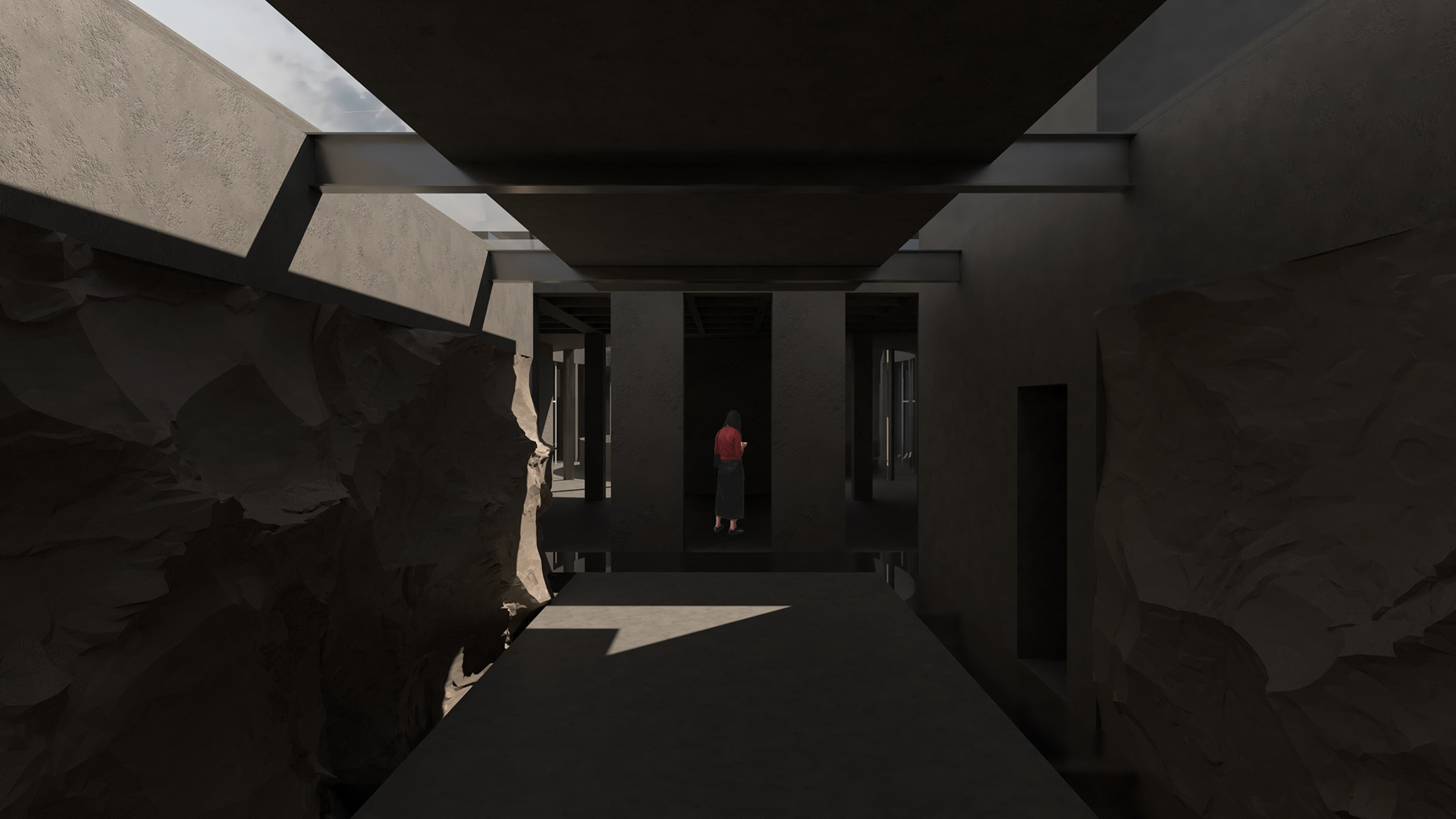
Image(Above): An interior look into the entrance of the exhibition hall from the underground tunnels
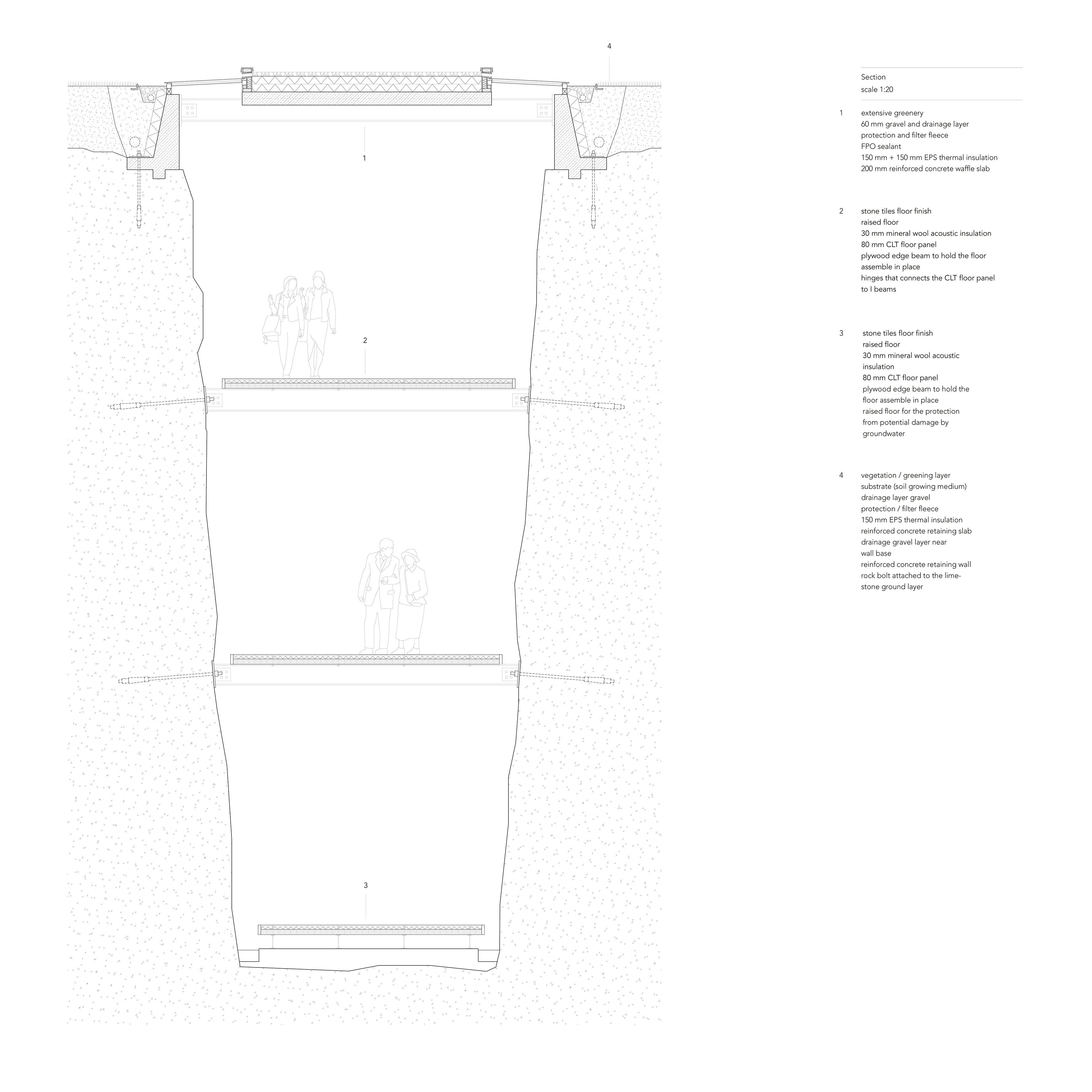
Image(Above): Detailed section of underground tuunels connectiong exhibition hall with the park showcasing the strategy of receiving natural daylight